
One data model for the whole trade cycle
EXIMnx is organised the way a trade office works: Masters, Export, Import, Compliance & EDI, Finance, Reports, AI, Integrations and Administration, with a live Dashboard on top. Every document carries a flow panel showing what came before it and what comes next.
Built around the agencies and systems Indian trade runs on
Every connector and rule set ships with the product. An administrator switches each one on once the endpoint and credentials are in place.
Pre-shipment to post-shipment, one chain
Quotations are versioned, and a discount over 10% routes for approval. Sales orders are gated by payment mode: advance, against BL, LC, DA or DP. Invoices carry a weight list and annexure, packing lists carry their own annexure, and the CHA checklist is generated for filing.
- Inquiry → Quotation → Proforma → Customer PO → Sales Order → Commercial Invoice → Packing List → Export Annexure → Checklist → Certificate of Origin
- Shipping Bills, BL/AWB, GST e-invoice and e-way bill registers; e-way bills expire automatically under CGST Rule 138(10)
- Pre-alerts, document dispatch, bank submission, export realisation and RBI closure
- Incentives register for Drawback and RoDTEP, with RoDTEP rules following FTP 4.54 to 4.59
- IGST refunds tracked claim → scroll → bank per CGST Rule 96; duty credit scrips
- Duty Savings view consolidates incentives, IGST refunds, licences, FTA benefits and scrips
Printable PDFs, stamped with admin-managed digital signatures.
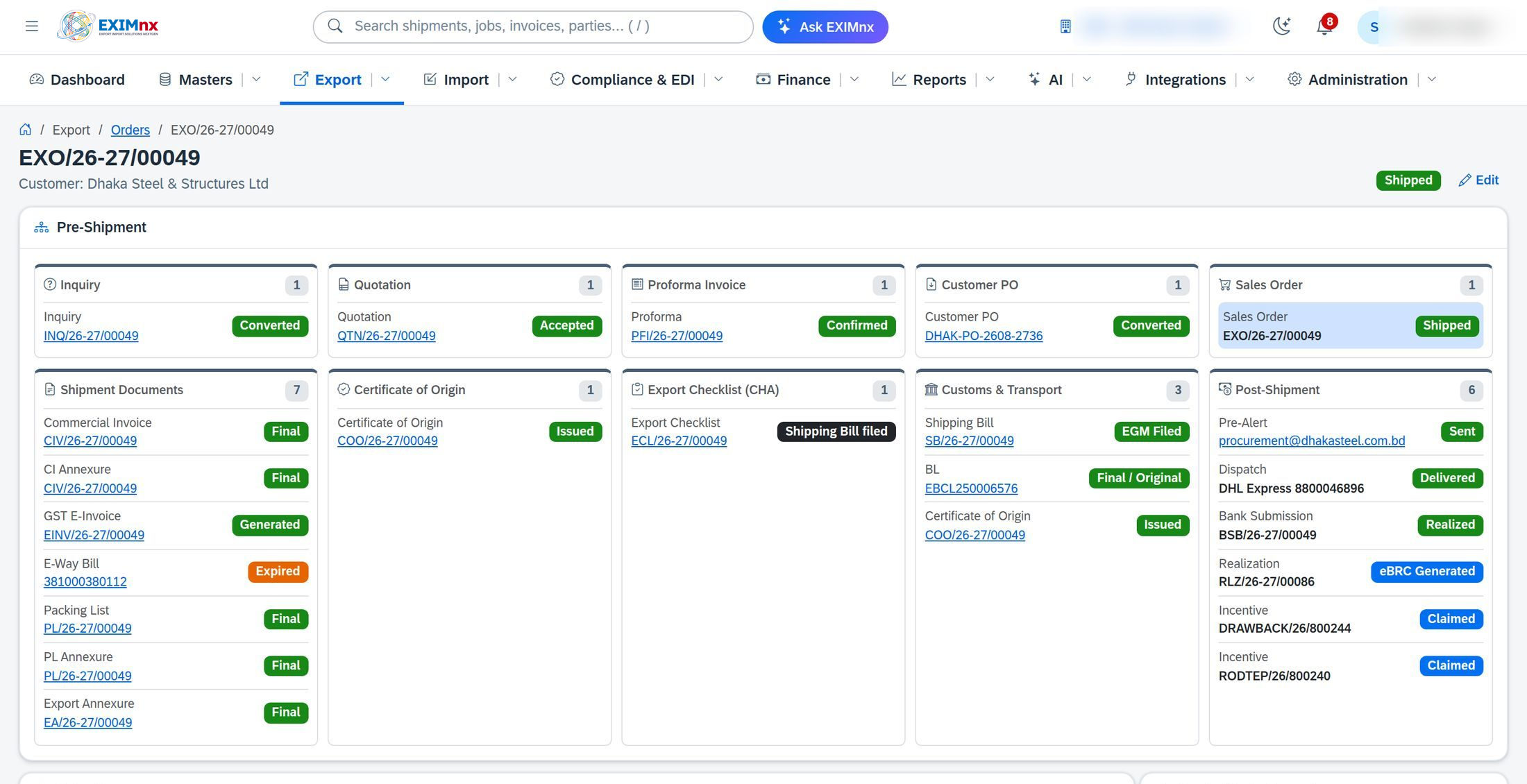 Export › Sales Order
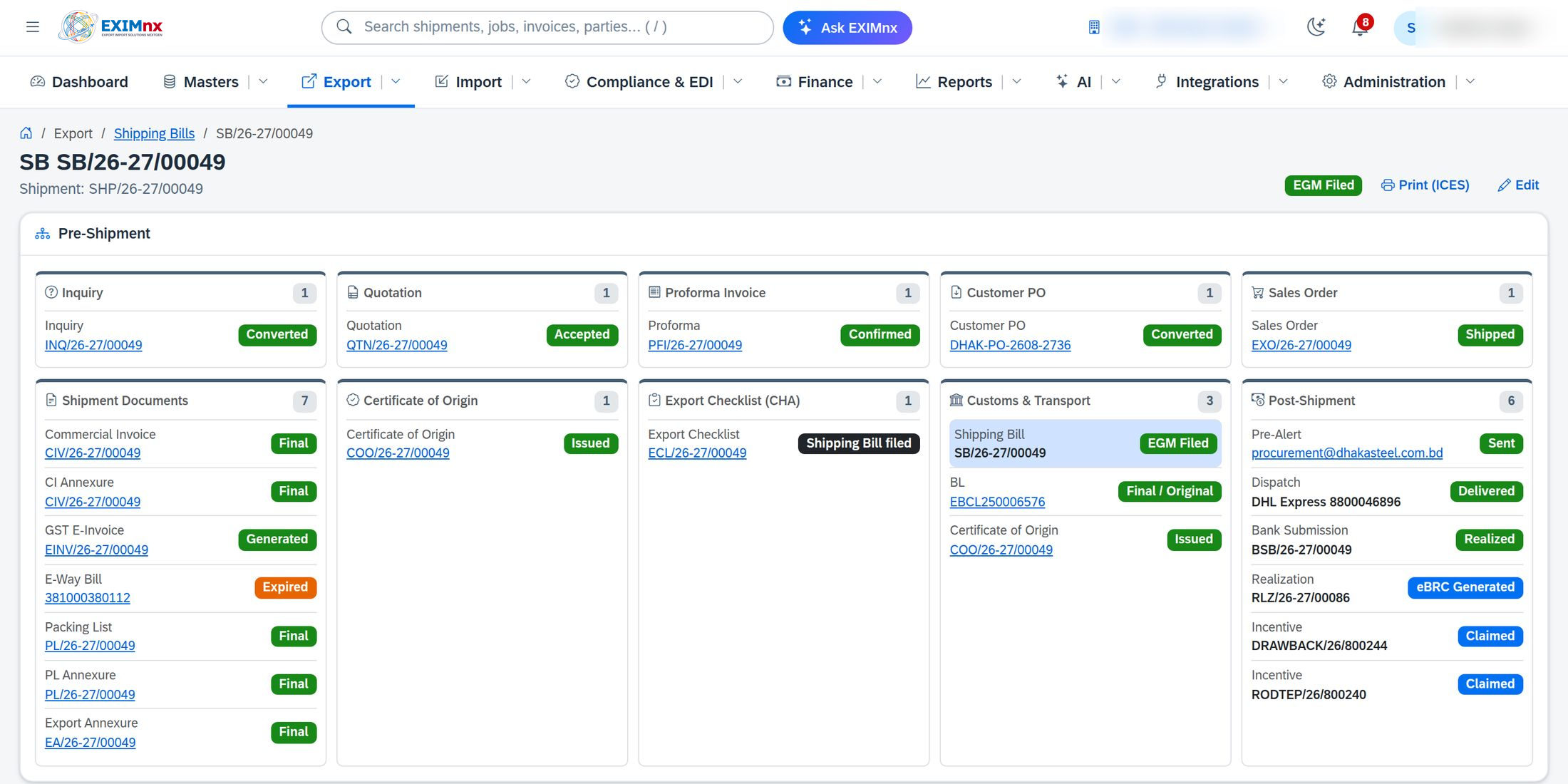
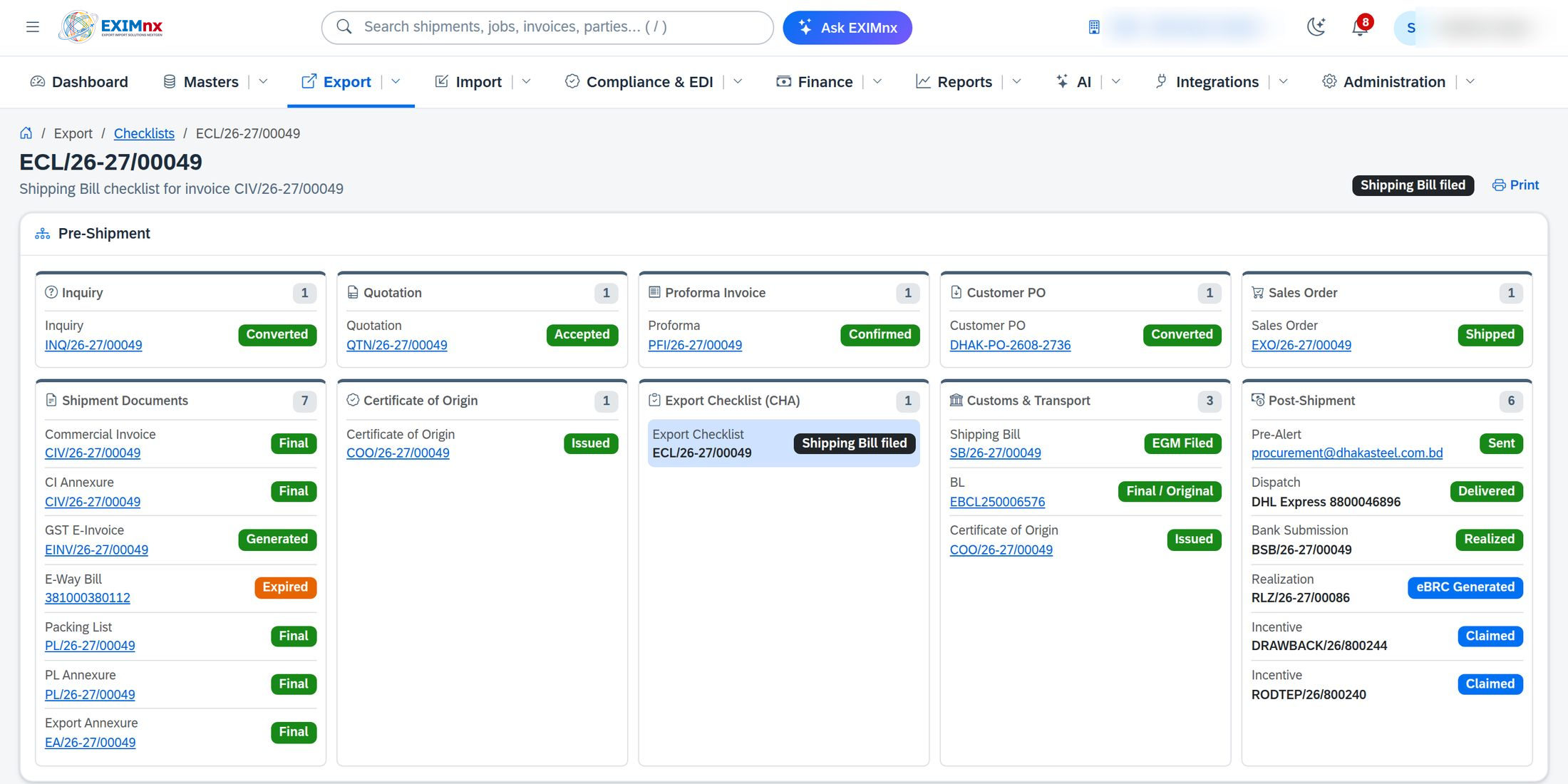
Procurement, clearance and post-clearance in sequence
The import cycle starts at the purchase requisition and ends with the licence debit. RFQs compare multiple vendors and record the award. Bills of Entry can be parsed by OCR from the customs copy.
- Purchase Requisition → RFQ → Import PO → Letter of Credit → Import Shipment → shipping documents
- Bill of Entry with OCR, import checklist, duty calculator, clearance board, inspections and bond register
- Export Obligations: AA/EPCG EO blocks, extensions and EODC; PIMS registrations
- Delivery Order, Transport Order, Warehouse Receipt/GRN with stock ledger
- Landed cost, three-way match, payment requests and import closure
- Import analytics alongside the export analytics views
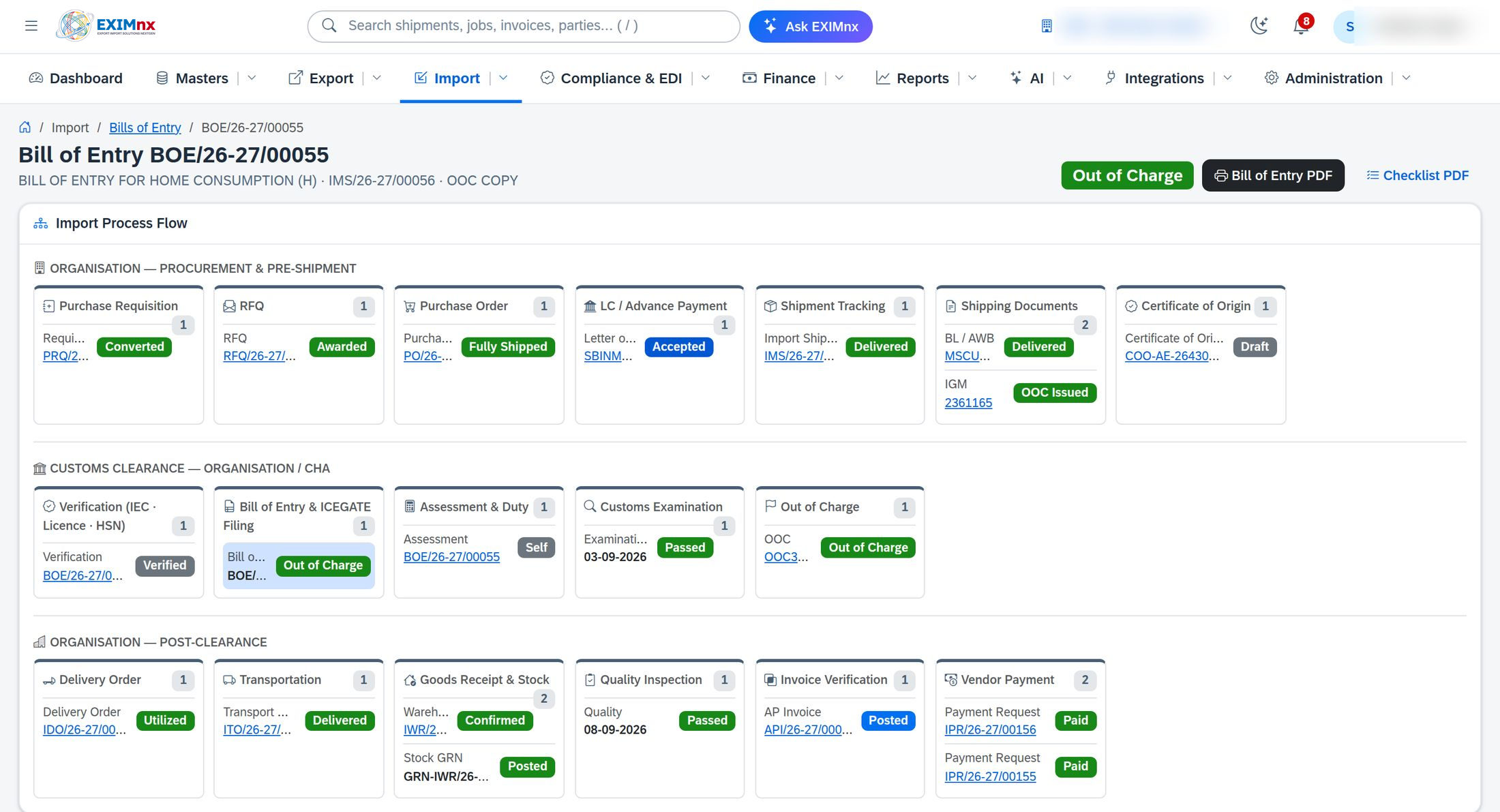 Import › Bill of Entry
The customs data plane
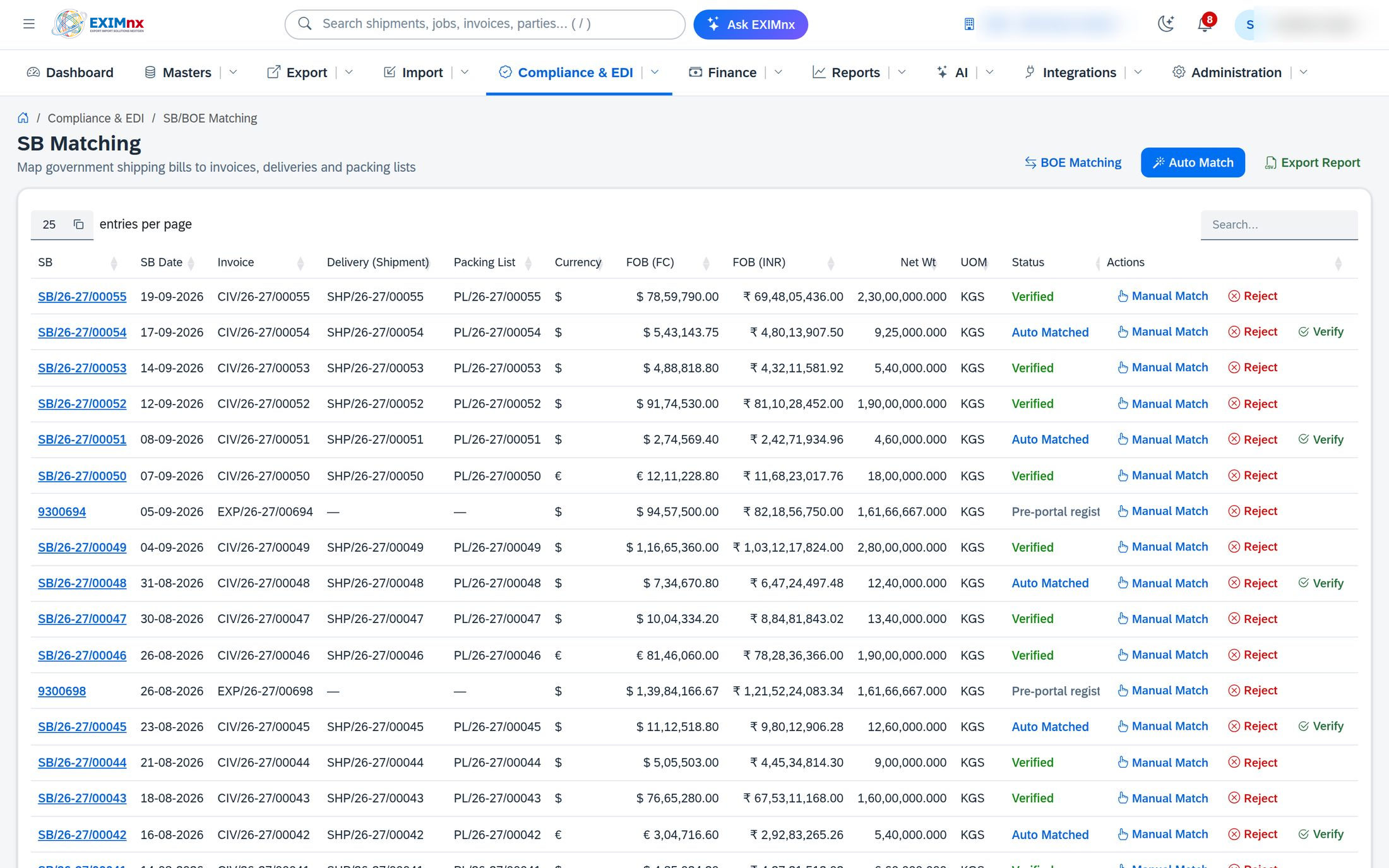
Shipping Bills and Bills of Entry are stored as ICES holds them, with RITC lines, drawback and RoDTEP blocks and eSanchit documents, then reconciled against your own transactions.
Import and store
Resumable, chunked imports from the ICEGATE connector or from SB/BOE copy files. Records keep every field customs sent.
Government reminders
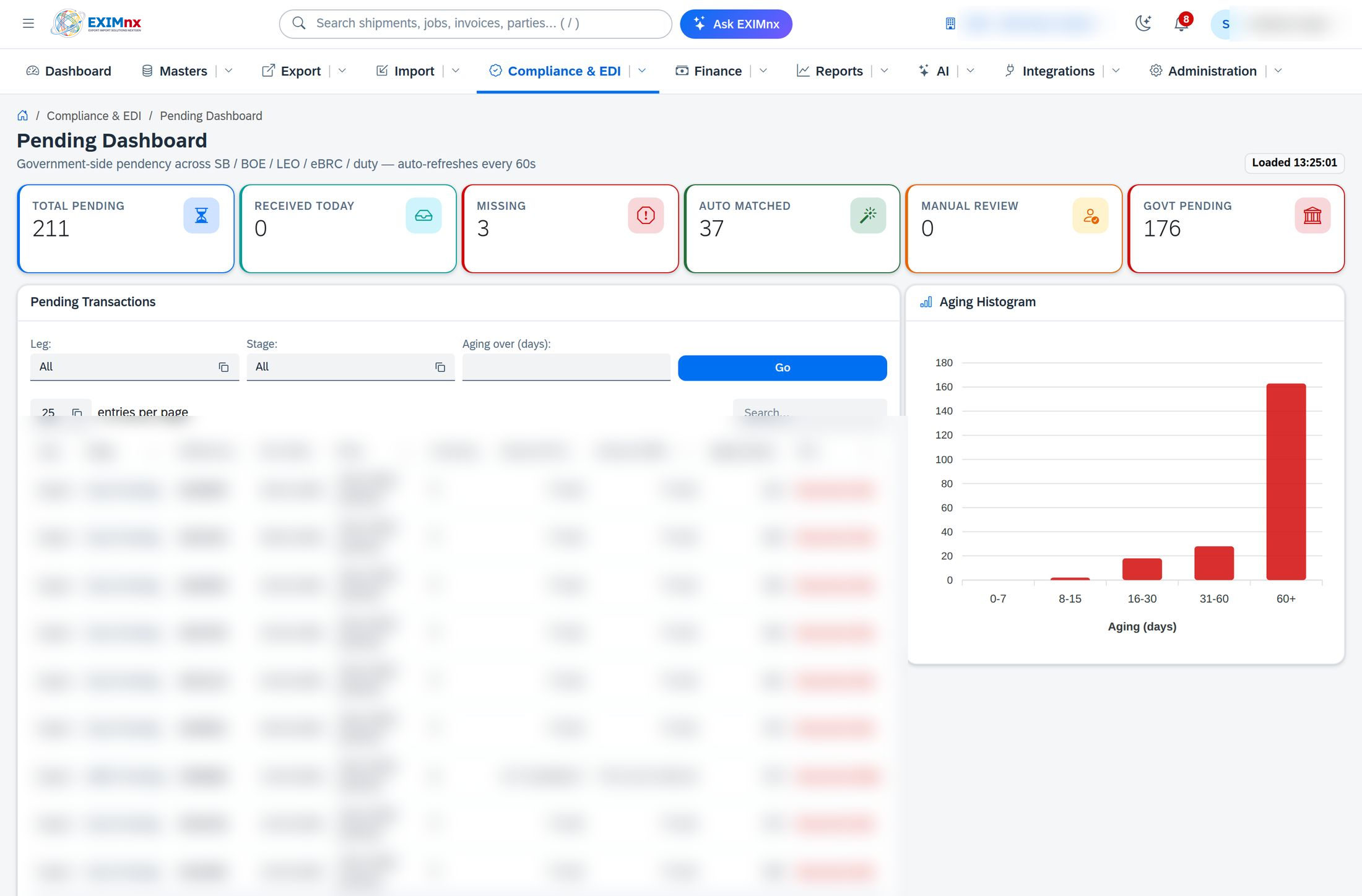
SLA-breach reminders escalated through three levels: invoice with no SB, SB with no LEO, LEO with no eBRC, shipment with no BOE, unpaid duty.
Filing files
ICES 1.5 CACHE01 flat files with SB, INVOICE, EXCHANGE, ITEM and DBK segments, ready for your CHA's ICEGATE ID. SB-to-DGFT transmission flagged after 72 hours.
From ANF-4A to EODC, with the rules enforced
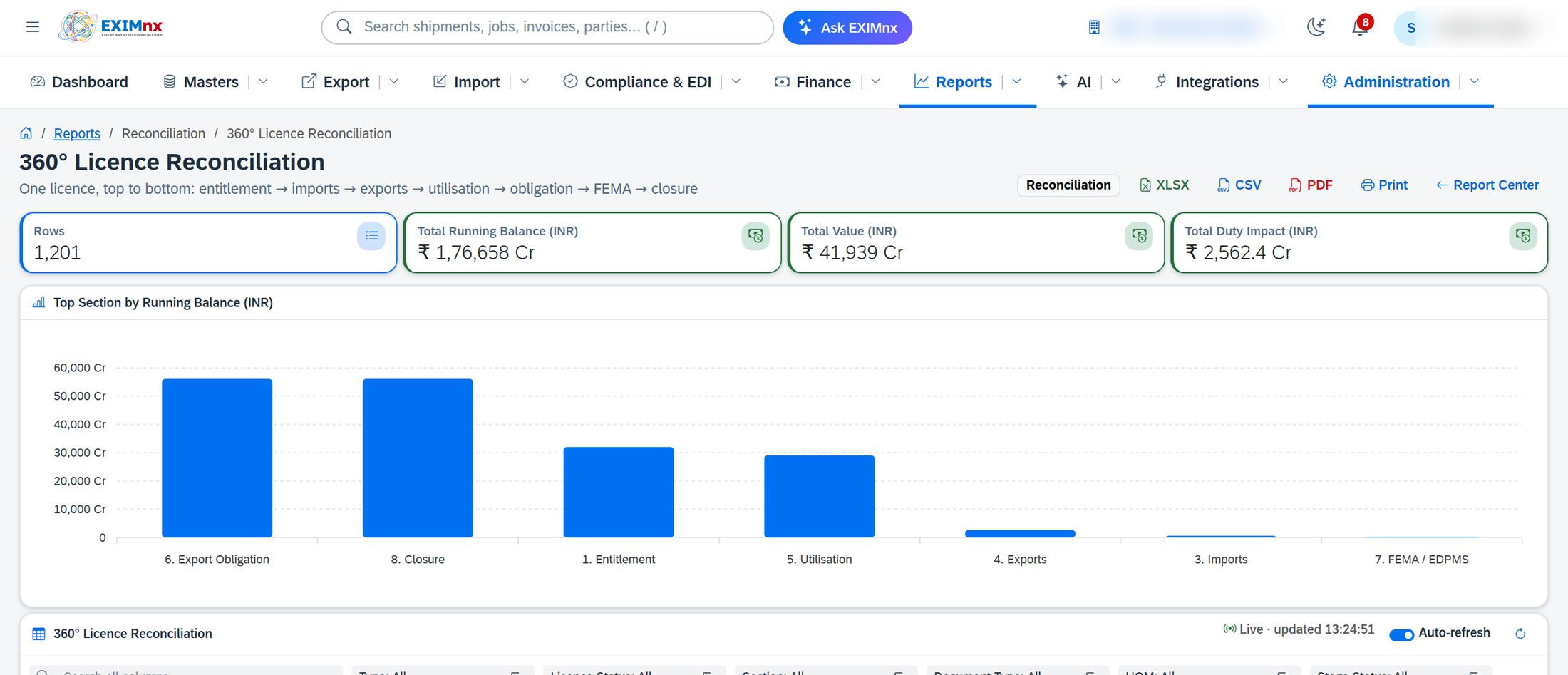
Licence applications reproduce ANF-4A field for field and can be imported by OCR from the DGFT copy. Authorisations are generated from the application and maintained as a ledger.
- Advance Authorisation, EPCG, DFIA and other schemes; SION norms in masters
- Ledger with Bill of Entry debits and Shipping Bill credits; alerts at 90% and 95% utilisation and 30 days before expiry
- Revalidation and EO-extension rules from FTP/HBP 2023, including EPCG EO = 6 × duty saved
- Invalidation letters and AROs; printable ANF-4A, authorisation and invalidation letter
- IEC register with annual-update check that blocks SB/BOE filing when missed; DSC expiry alerts
- ITC(HS) policy check: prohibited lines block Shipping Bill and Bill of Entry filing
 Reports › Licence Utilisation
 Reports › 360° Licence Reconciliation
Bank statements matched to shipments, through to closure
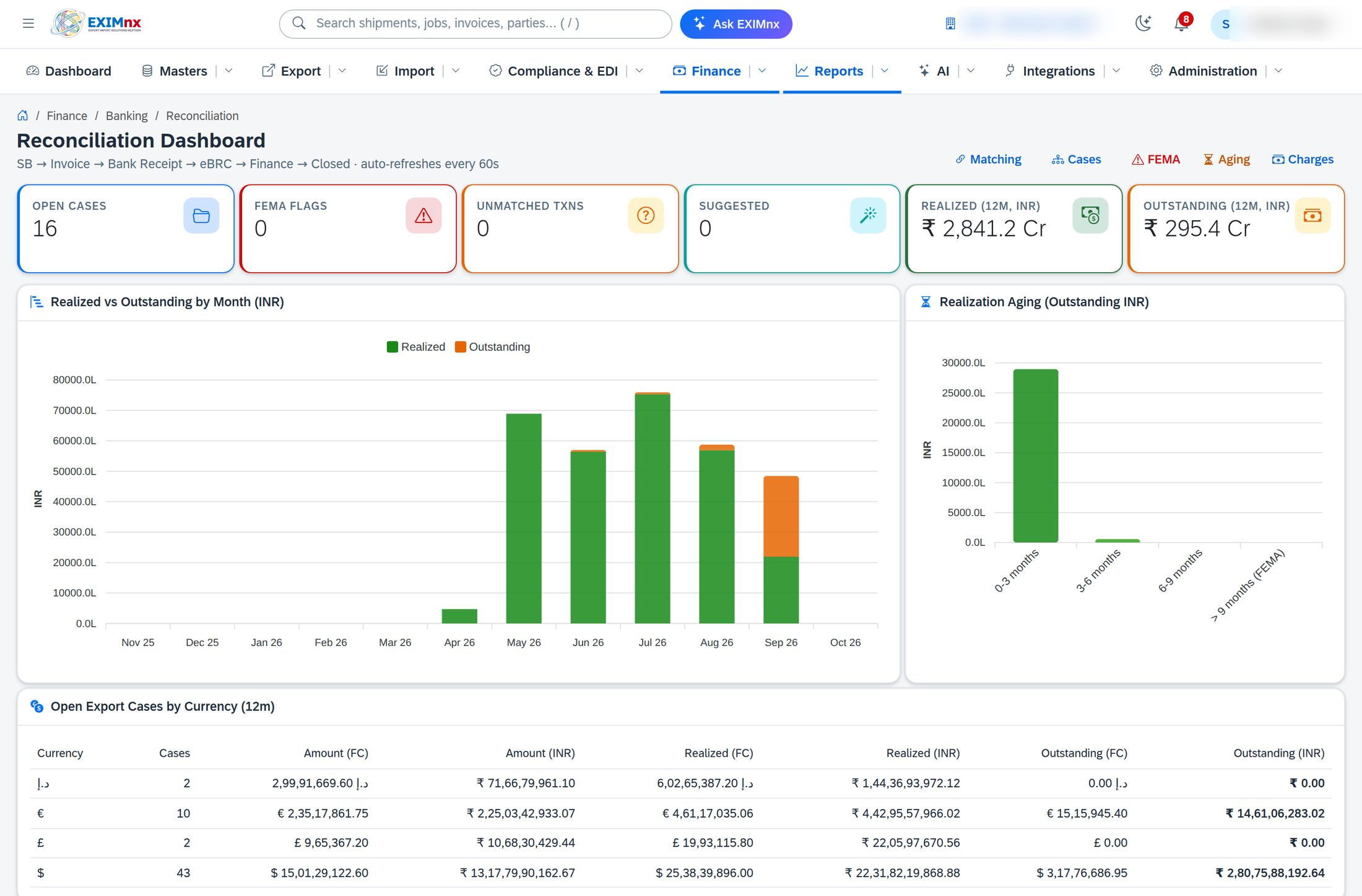
BankLink imports statements, suggests matches and walks each shipment to its eBRC. Suggestions are fuzzy, so a short-paid remittance or a bank charge does not block the chain.
- Statement parsers for MT940, CAMT.053, CSV and SWIFT MT
- Export chain: SB → Invoice → Receipt → eBRC → closed. Import chain: BOE → AP → Payment → Remittance
- FEMA flag on any realisation approaching nine months
- eBRC self-generation through the DGFT eBRC API: fetch IRMs → draft → push → poll → book
- FIRC, SWIFT messages, Letters of Credit and remittances in one register
- Bank charges and realisation ageing reports
 Finance › Banking › Reconciliation
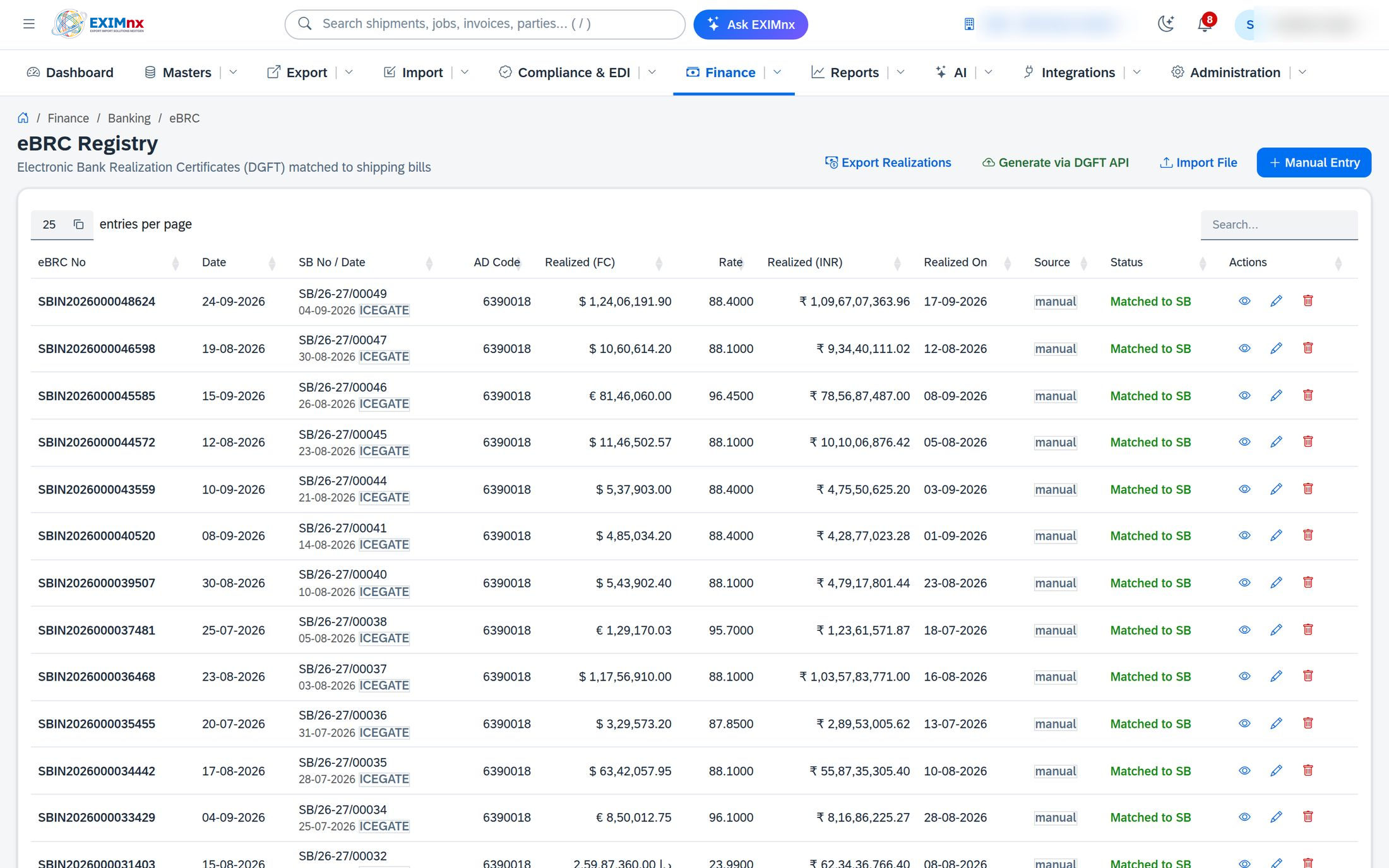 Finance › Banking › eBRC
Screening, gates and EDI in the flow, not after it
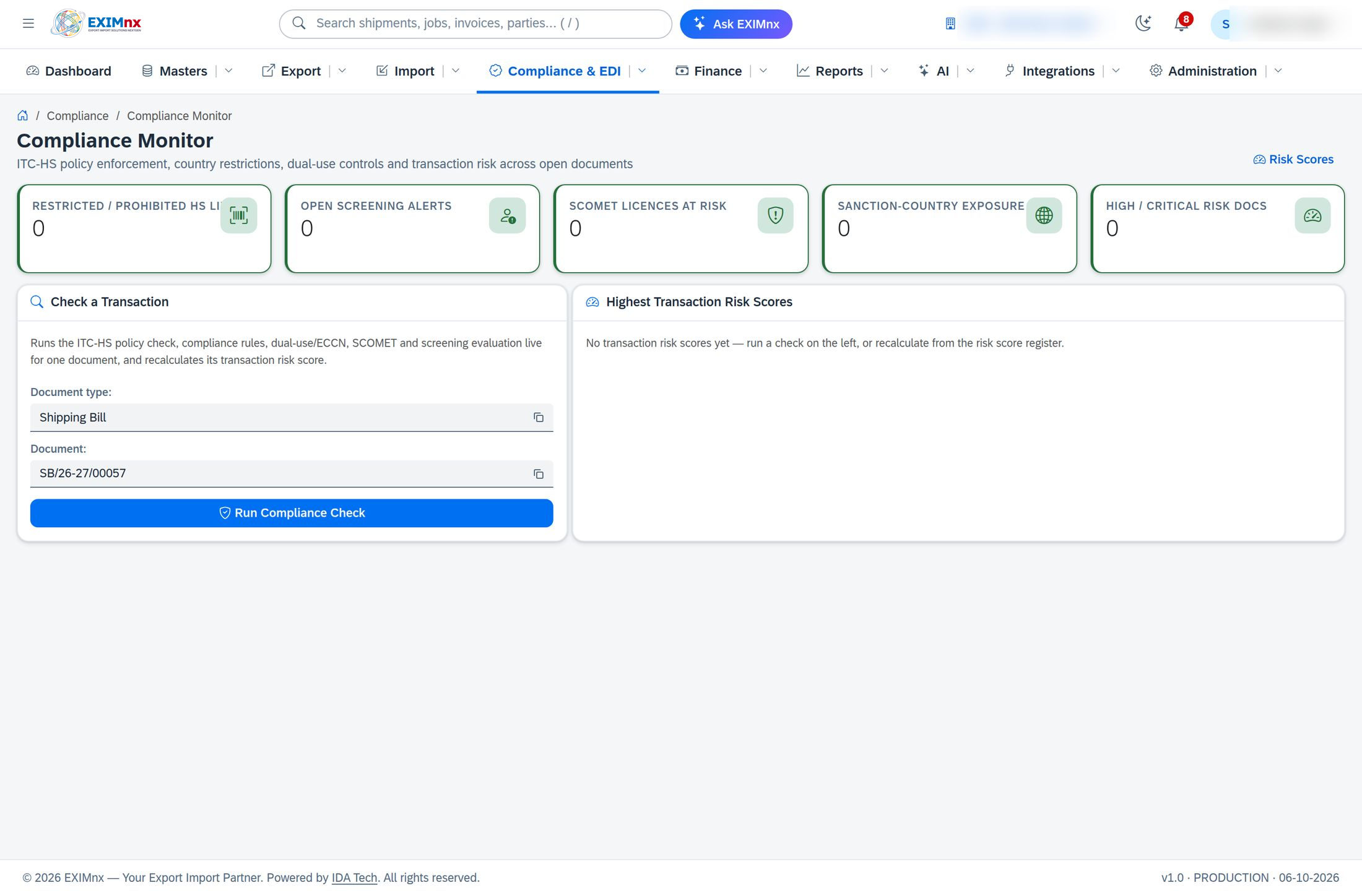
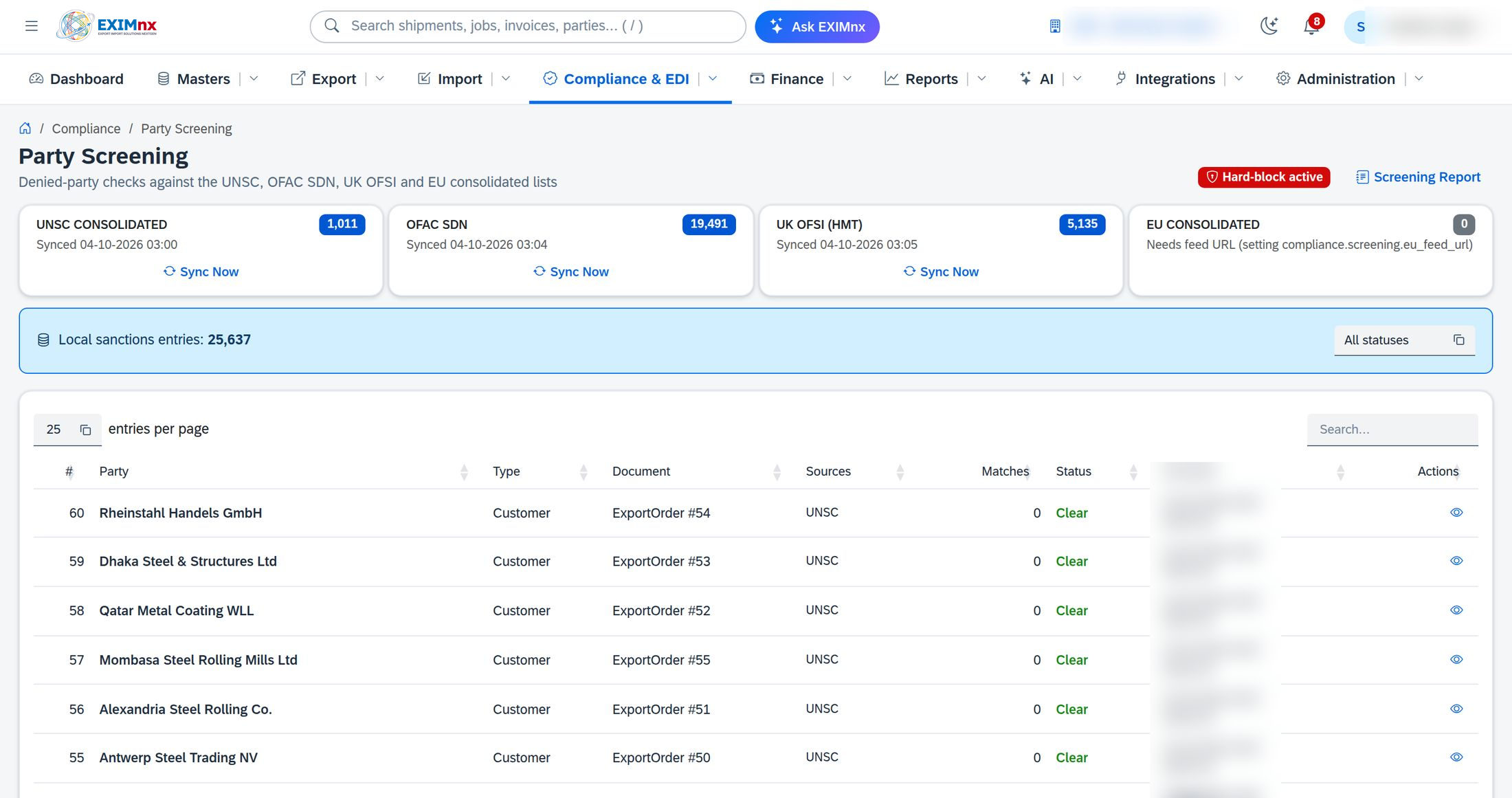
Transaction risk scores
Each transaction gets a risk score from configurable rules so reviewers see the exceptions first.
SCOMET and ITC(HS) gates
SCOMET licences are recorded and restricted or prohibited lines are stopped before filing.
FTA, origin and EDI
Agreements, rules of origin and origin assessments per product and destination. EDI messages: mapping → XML → ICEGATE flat file.
Receivables, payables and banking that understand FX
Finance in EXIMnx is built for trade: every invoice, receipt and payment knows its currency, its exchange rate and the shipment it belongs to.
- AR and AP invoices, receipts, payments, credit and debit notes with FX allocation
- Bank guarantees and letters of credit tracked with expiry
- Double-entry voucher engine, chart of accounts, TDS sections, cost and profit centres, budgets
- Printable AR, AP, receipt, payment and ageing documents
- LUT and IGST-paid exports, IRN and e-way bill registers, IGST refund tracking, BOE IGST credit, GST rate lookup
 Finance › Receivables › AR Invoices
One drill-down from licence to closure
The EXIM Control Tower is a single screen across Licence → Utilisation → SB → BOE → Customs → EO → EDPMS → IDPMS → Realisation → eBRC → FEMA → Exception → Closure. A reconciliation score is snapshotted daily.
 Reports › EXIM Control Tower
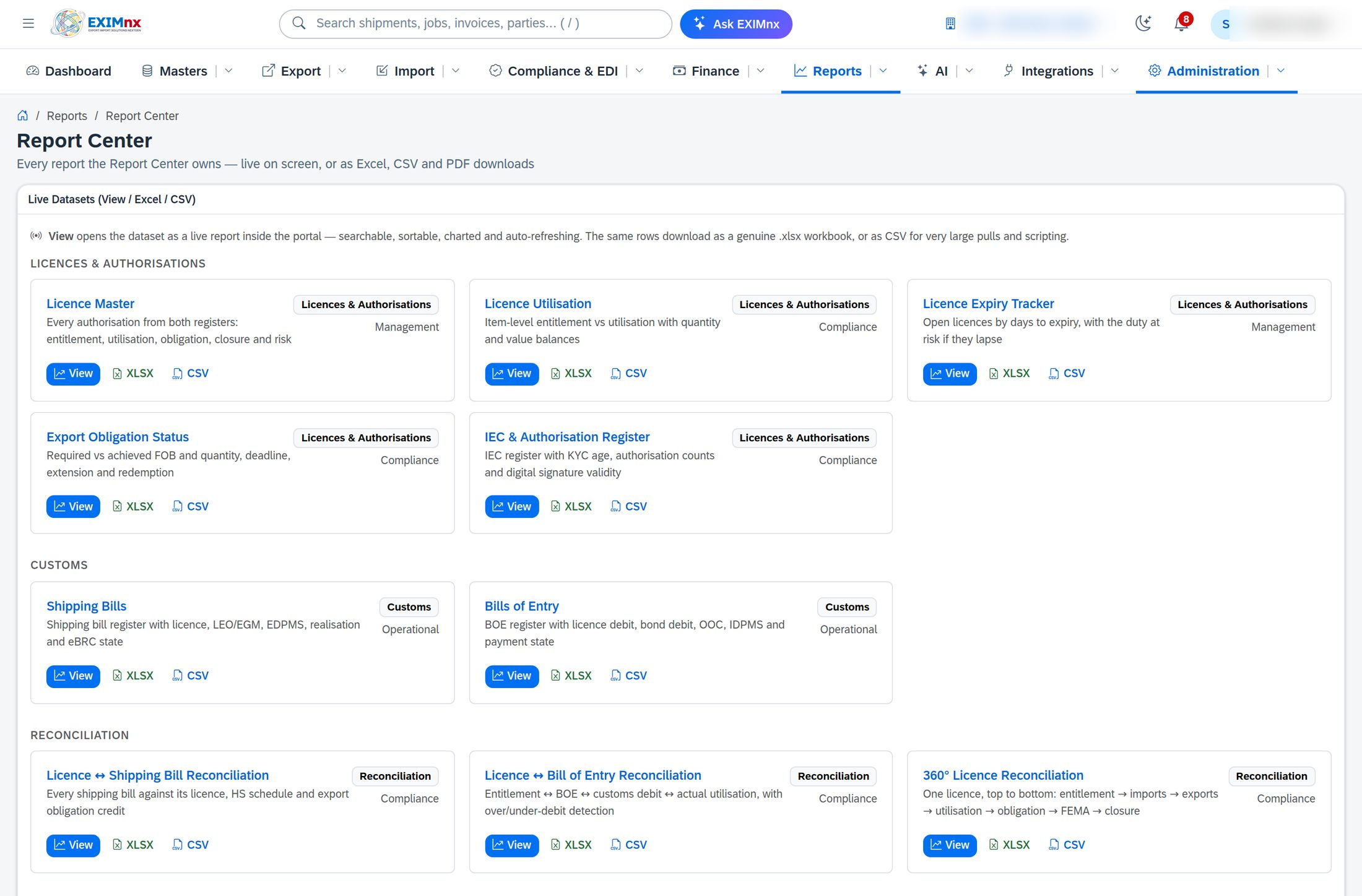
EDPMS and IDPMS positions are derived inside EXIMnx from your shipments and bank data. They are not read back from RBI.
Fifty-five masters, SAP-style where it matters
Geography
Countries, states, cities, ports, airports, ICDs.
Organisation
Companies, branches, plants, divisions, departments, warehouses, employees, bank accounts.
Sales area
Sales organisation, distribution channel, division, sales office, sales group, document types.
Trade
Currencies, exchange rates, taxes, GST rates, HS/HSN codes, Incoterms, payment terms, scheme codes, SION norms, ECCN.
Parties
Customers, suppliers, CHAs, shipping lines, airlines, forwarders, transporters, banks, insurers.
Items
Products, materials, services, packaging, commodities, dangerous goods.
Logistics
Container types, vehicles, drivers.
Customs
Tariff and customs notifications. Every master has server-side lists and CSV export.
Access control, audit and IT general controls
Multi-company
Company picker after sign-in, a switcher in the header, and a consolidated "All companies" view for authorised admins. Records are also scoped by branch.
Roles & permissions
Permission-slug RBAC on every menu item and route. Users, roles, active sessions and system settings in one place.
Sign-in security
TOTP two-factor authentication, throttling after five failed attempts, session control.
Audit & logs
Audit logs, activity logs, background job monitor, integration logs and inbound API request log.
IT audit (ITGC)
Access-review campaigns with sign-off, and ITGC evidence reports for access, audit-trail integrity and computer operations, exportable to XLSX, CSV and PDF.
Notifications
Notification center with templates and rules routed over email, SMS and WhatsApp.
Want the module-by-module walkthrough?
A demo follows the 21-step export cycle and the 13-step import cycle on your own documents.