

- The Harmonized System (HS), maintained by the World Customs Organization, is the same worldwide to 6 digits. India adds two more to make an 8-digit tariff item, used in the Customs Tariff and in ITC(HS).
- Classification follows the General Rules of Interpretation (GRI 1 to 6), applied in order, together with the section and chapter notes.
- If you are unsure, you can get a binding answer through an advance ruling from the Customs Authority for Advance Rulings.
How an HS code is built
The HS groups all goods into 21 sections and 97 chapters (chapter 77 is reserved for future use). Each chapter is divided into 4-digit headings and 6-digit subheadings. Every customs administration that uses the HS shares these first six digits; India's Customs Tariff and the ITC(HS) classification add two digits for national detail.
Why the code matters
| What it decides | Where it comes from |
|---|---|
| Customs duty on imports | The rate against the tariff item in the First Schedule to the Customs Tariff Act |
| GST rate | GST rate notifications, which are organised by HSN (the same HS-based code) |
| Drawback and RoDTEP | The drawback schedule and Appendix 4R list rates by tariff item; the wrong code means the wrong rate or none |
| Export policy | ITC(HS) Schedule 2 marks items as free, restricted (licence needed) or prohibited, sometimes with conditions |
| Import policy | ITC(HS) Schedule 1, for inputs you import |
| FTA origin | Product-specific rules of origin are written against HS headings and subheadings |
Your buyer's customs will classify the same goods at 6 digits too. If your invoice and Certificate of Origin show a different subheading from the one they apply, an FTA claim can be denied at destination.
The General Rules of Interpretation
Classification is not a keyword search. The six General Rules of Interpretation are applied in order, and you only move to the next rule if the previous one does not settle the question.
- GRI 1: classify by the terms of the headings and the section and chapter notes. Section and chapter titles are for reference only. Most goods are settled here.
- GRI 2: (a) incomplete, unfinished or unassembled goods are classified as the finished article if they have its essential character; (b) mixtures and combinations are covered by headings for their materials, which leads into GRI 3.
- GRI 3: when two or more headings could apply, choose (a) the most specific description, then (b) the material or component giving essential character, then (c) the heading that comes last in numerical order.
- GRI 4: goods that fit no heading go to the heading for the goods they are most akin to.
- GRI 5: cases and containers made for the article, and normal packing, are generally classified with the goods.
- GRI 6: the same logic applies at subheading level, comparing only subheadings at the same level.
Common mistakes
Classifying by use or trade name. The tariff classifies by what the goods are (material, function, form) as described in the headings and notes, not by what your industry calls them.
Copying the supplier's or last year's code. Tariff lines change, including with periodic HS amendments. Recheck codes when the tariff is amended or the product changes.
Different codes on different documents. The invoice, Shipping Bill, GST e-invoice and Certificate of Origin should all carry the same code. Mismatches trigger queries and can hold refunds and incentives.
Ignoring the policy column. A correct code on a restricted item still needs the licence or condition that ITC(HS) Schedule 2 requires.
When to seek an advance ruling
For a new product, a high-value contract or a genuinely arguable classification, you can apply to the Customs Authority for Advance Rulings (CAAR) under the Customs Act. A ruling on classification is binding on you and on customs for the goods and facts you described, which removes the risk of a later dispute and demand. Keep product literature, drawings, composition and process details ready, because the ruling is only as good as the description you give.
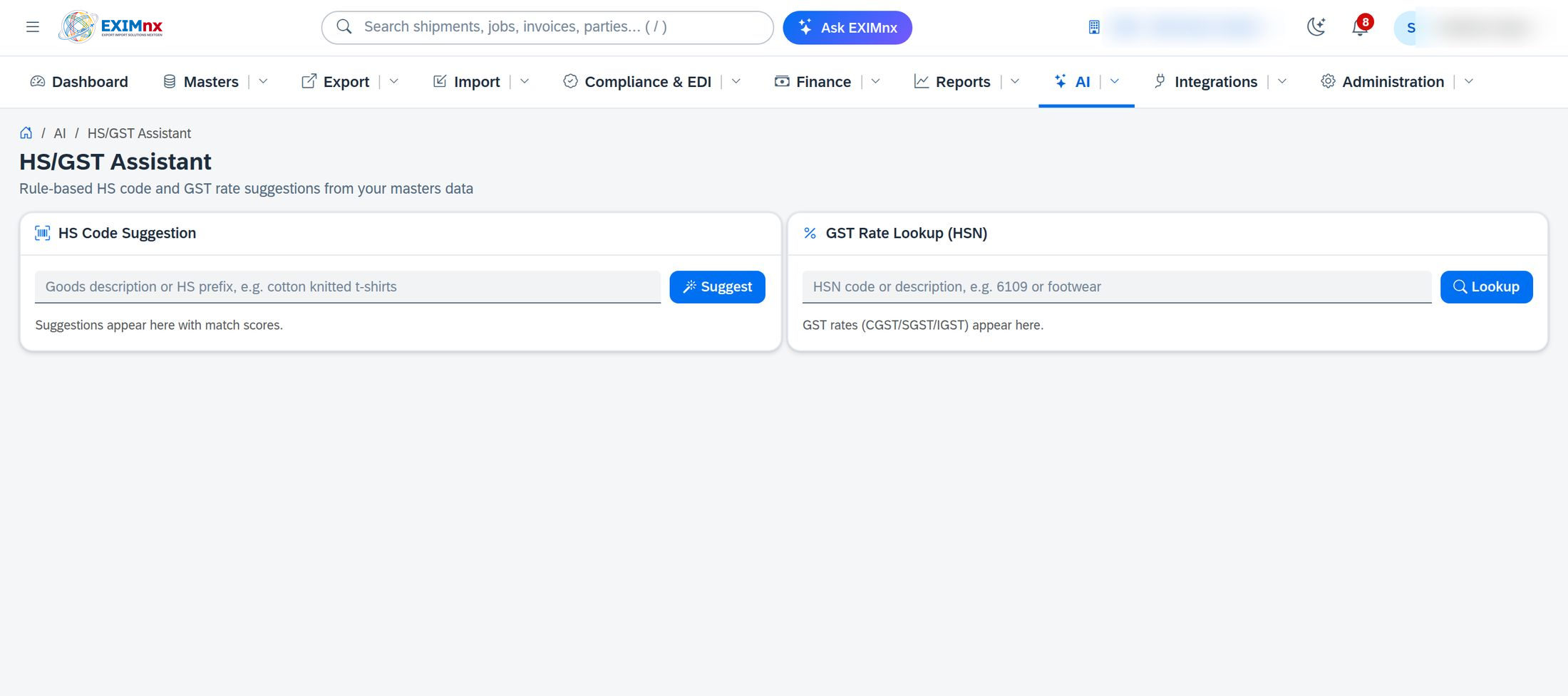
How EXIMnx helps: the HS/GST Assistant suggests HS codes with match scores from a product description and looks up the GST rate by HSN. The compliance engine checks HS codes against licence-required and restricted lists before filing. See AI in EXIMnx.
- World Customs Organization, Harmonized System: wcoomd.org
- Customs Tariff and Customs Authority for Advance Rulings: cbic.gov.in
- ITC(HS) Schedules 1 and 2: dgft.gov.in
This guide is a practical overview, not legal advice. Classification depends on the exact goods; check the current tariff and notes or seek a ruling.