

- The carrier files the IGM; you (or your customs broker) file the Bill of Entry on ICEGATE, ideally before the goods arrive.
- Customs assesses it, you pay the duty, the goods are examined if the risk system selects them, and customs gives out of charge.
- Duty is built in layers on the assessable value: basic customs duty, then Social Welfare Surcharge on that duty, then IGST on the running total.
Types of Bill of Entry
The clearance steps
- IGM. The shipping line or airline files the Import General Manifest listing the cargo on board. Your Bill of Entry is matched against its line number.
- Bill of Entry. Filed electronically on ICEGATE, usually by your customs broker, with the invoice, packing list, bill of lading or airway bill, HS classification, the duty exemptions claimed and any licence such as an Advance Authorisation. The Customs Act expects it to be filed in advance, before the goods arrive; late filing attracts charges.
- Assessment. The importer self-assesses the duty. Customs' Risk Management System decides whether the entry is accepted as is, sent to an officer for assessment, or marked for examination.
- Duty payment. Pay online against the assessed Bill of Entry. Late payment attracts interest.
- Examination. If selected, customs examines the goods at the port, airport or container freight station against the declared description.
- Out of charge. Customs releases the goods. The terminal or CFS then issues the gate pass against the carrier's delivery order.
Assessable value
Customs duty is charged on the assessable value: the transaction value of the goods on a CIF basis, that is cost plus insurance plus freight to the Indian port. Since the 2017 amendment of the Customs Valuation Rules, the old 1% landing charge is no longer added.
- If you buy FOB or EXW, add the actual freight and insurance. Where these are not known, the valuation rules prescribe notional amounts.
- Foreign-currency values are converted at the customs exchange rate notified by CBIC, not your bank's rate.
- Certain costs paid by the buyer, such as some royalties and commissions, may have to be added to the value.
How the duty is calculated
Duty is built in layers, each on top of the last:
| Component | Charged on | Example |
|---|---|---|
| Assessable value (AV) | CIF value in rupees | ₹1,00,000 |
| Basic customs duty (BCD) | AV × the tariff rate for the HS code (10% here) | ₹10,000 |
| Social Welfare Surcharge (SWS) | 10% of BCD, unless exempted | ₹1,000 |
| IGST | (AV + BCD + SWS) × the GST rate (18% here on ₹1,11,000) | ₹19,980 |
| Compensation cess | Same base as IGST, only for goods that attract it (for example some tobacco products and motor vehicles) | nil |
| Total duty | ₹30,980 |
Rates in this example are illustrative. Real rates depend on the HS code, the effective-rate notifications, any FTA preference with a valid certificate of origin, and levies such as AIDC or anti-dumping duty on specific goods. IGST paid on import is usually available to registered businesses as input tax credit; BCD and SWS are not.
The landed cost, on one chart
Landed cost build-up for a ₹1,00,000 import
Illustrative rates: BCD 10%, SWS 10% of BCD, IGST 18%. Hover or tab to a segment for details.
Show as a table
| Component | Amount | Share of landed cost |
|---|---|---|
| Assessable value | ₹1,00,000 | 76.3% |
| Basic customs duty | ₹10,000 | 7.6% |
| Social Welfare Surcharge | ₹1,000 | 0.8% |
| IGST | ₹19,980 | 15.3% |
| Landed cost (before port and freight-forwarding charges) | ₹1,30,980 | 100% |
Where clearance gets delayed
Classification disputes. A different HS code from the one customs expects changes the rate and triggers a query. Keep a product-wise classification record with the reasoning behind each code.
Valuation queries. A declared price well below comparable imports invites a valuation check. Keep the contract, proof of payment and freight invoices ready.
Late filing and demurrage. A Bill of Entry filed after arrival, or duty paid late, adds charges, and each day at the port adds demurrage and detention.
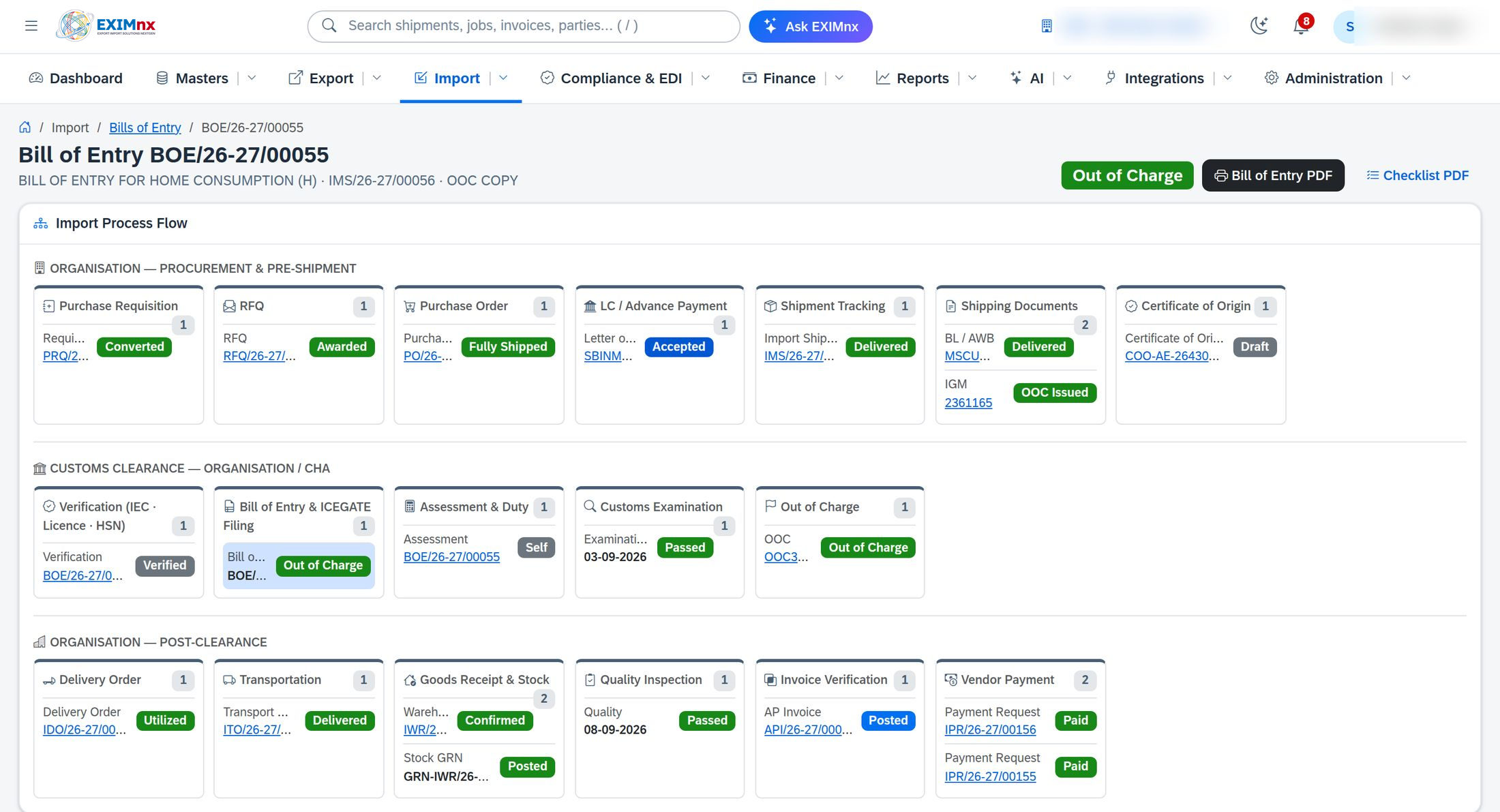
How EXIMnx helps: EXIMnx reads the Bill of Entry by OCR from the customs copy, generates the import checklist and runs a duty calculator before filing. Its clearance board tracks assessment, examination and out of charge. It allocates freight, insurance, duty, clearing and transport into a landed cost per item, and posts the debit to the Advance Authorisation ledger when you import under a licence. See the Import module.
- CBIC: Customs Act, Customs Tariff, valuation rules and exchange-rate notifications: cbic.gov.in
- ICEGATE, Bill of Entry filing and duty payment: icegate.gov.in
This guide is a practical overview, not legal or tax advice. Rates and procedures change by notification; check the current tariff for your HS code.