

- Duty drawback returns customs duty paid on inputs, as cash to your bank account.
- RoDTEP returns embedded taxes not refunded elsewhere (fuel, power, mandi tax and so on), as a transferable e-scrip.
- IGST refund returns the IGST you paid on the export, as cash. Or you export under LUT, pay no IGST and claim back your input credit instead.
The three schemes compared
| Duty drawback | RoDTEP | IGST refund | |
|---|---|---|---|
| What it returns | Customs duty on imported inputs | Central, state and local taxes embedded in the product | IGST paid on the export invoice |
| Rate basis | All Industry Rate by tariff item, or a brand rate | Rate by HS line in Appendix 4R, some with per-unit caps | The IGST actually paid |
| How it is claimed | Declared in the Shipping Bill | Opted for in the Shipping Bill | Shipping Bill is the claim, once EGM and GST returns are filed |
| Paid as | Cash to your bank account | E-scrip in the ICEGATE duty credit ledger | Cash to your bank account |
| Main rule | Customs and Central Excise Duties Drawback Rules, 2017 | Foreign Trade Policy 2023 | IGST Act s.16; CGST Rule 96 |
Drawback and RoDTEP return different taxes, so a shipment can usually claim both. Eligibility for exports under Advance Authorisation, EOU and SEZ has changed several times by notification, so check the current position for those.
Where the money goes
Duty drawback
Drawback refunds customs duty paid on imported materials used in the export product. Most exporters use the All Industry Rate (AIR) published in the drawback schedule against each tariff item, which works as a percentage of FOB value, sometimes with a cap per unit. If no AIR exists, or it is clearly too low, you can apply for a brand rate based on your actual input costs.
No separate application is needed for AIR: the Shipping Bill is the claim. Once customs processes it, the amount is paid straight to the bank account you registered with customs.
RoDTEP
The Remission of Duties and Taxes on Exported Products scheme returns taxes that no other scheme refunds: VAT on fuel used in transport, electricity duty, mandi tax, stamp duty on export documents and similar. Rates are notified per HS line in Appendix 4R.
- Opt for RoDTEP in the Shipping Bill. A missed declaration is hard to fix later.
- The credit is issued as an e-scrip in your Electronic Duty Credit Ledger on ICEGATE.
- Use the scrip to pay basic customs duty on your own imports, or transfer it to another importer.
- Scrips have a limited validity, so use or transfer them promptly.
IGST refund, or LUT
Exports are zero-rated under GST, and you choose one of two routes:
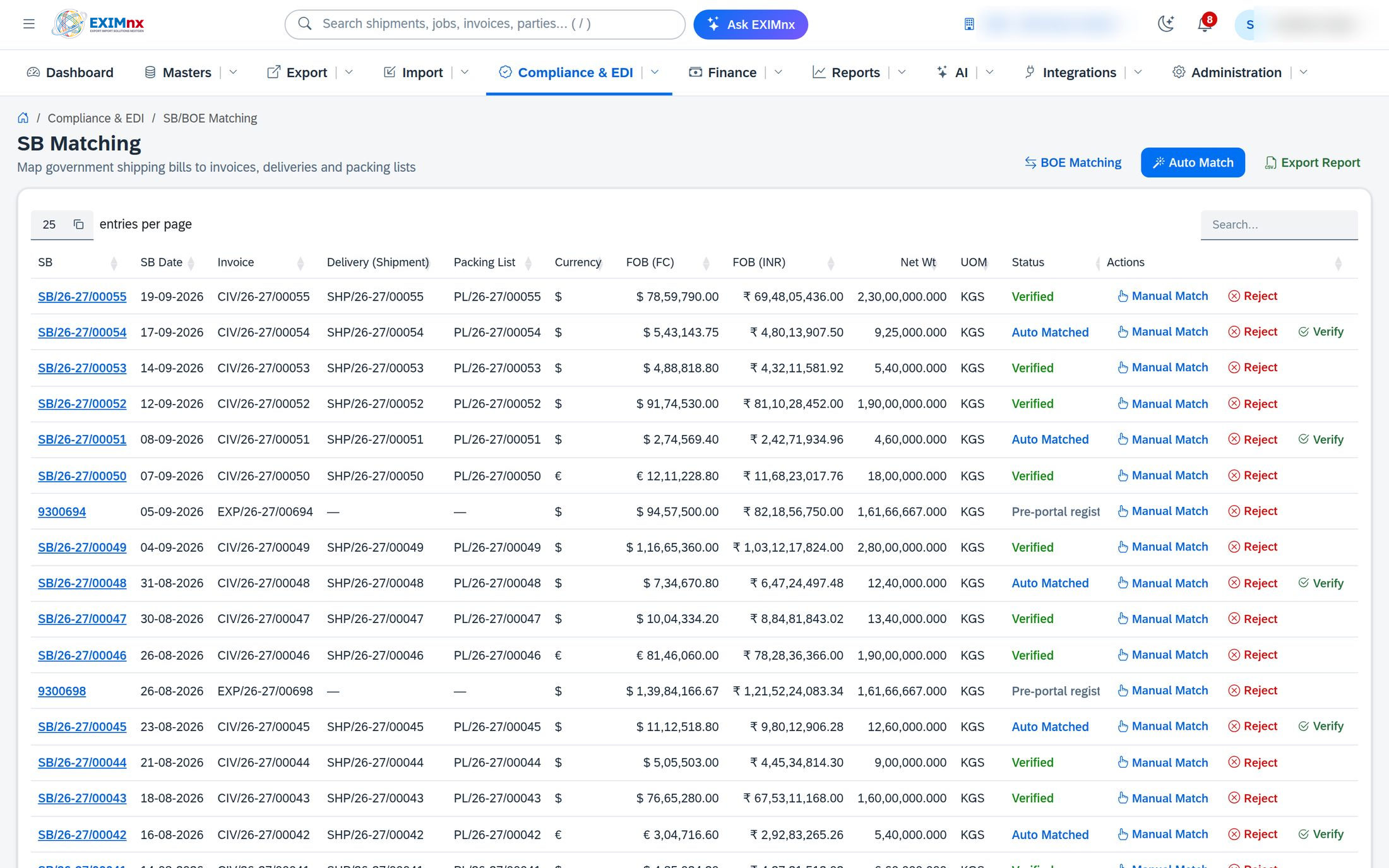
On the IGST-paid route, the Shipping Bill counts as your refund application once two things exist: the EGM (export general manifest) filed by the carrier, and your GSTR-3B for the period. The invoice details you report in GSTR-1 (Table 6A) are sent to customs and matched against the Shipping Bill. If they match, a scroll is generated and the refund reaches your bank account.
Why claims get stuck
Invoice data differs between the Shipping Bill and GSTR-1: number, date, value or GSTIN. This is the biggest single cause of held IGST refunds.
EGM not filed or not matched. Without the carrier's manifest, customs cannot treat the export as complete.
Bank account not validated with customs. Refunds and drawback cannot be paid to an account that has not been registered and validated.
RoDTEP not opted or scrip left to lapse. Check every Shipping Bill for the declaration, and track scrip balances and expiry.
How EXIMnx helps: the Incentives register tracks drawback and RoDTEP per Shipping Bill. IGST refunds are followed from claim to scroll to bank credit, and the Duty Savings view totals it all. See the Export module.
- CBIC (drawback schedule, IGST refund circulars): cbic.gov.in
- DGFT (RoDTEP, Appendix 4R): dgft.gov.in
- ICEGATE (e-scrip ledger, refund status): icegate.gov.in
This guide is a practical overview, not legal or tax advice. Rates and eligibility change by notification.