

- The cycle runs in four phases: pre-shipment, customs & shipment, realisation and post-shipment benefits.
- Each document should be generated from the one before it. Retyping is where invoice-number and value mismatches come from, and those mismatches block IGST refunds and eBRCs later.
- The Shipping Bill is the pivot: it is the customs declaration, the drawback and RoDTEP claim, the IGST refund application and the record that starts the FEMA realisation clock.
The four phases at a glance
Most exporters think of the process as "make the invoice, file the Shipping Bill, ship". In practice there are 21 distinct steps, and the second half (after the goods leave) is where money is won or lost.
Pre-shipment: inquiry to sales order (steps 1–5)
- Inquiry. Record the buyer, products, quantities, Incoterm and destination. Run the buyer through denied-party screening now, not after the goods are packed.
- Quotation. Price, validity, Incoterm and payment terms. Keep versions: the accepted version is what the invoice must match.
- Proforma invoice. Raised from the accepted quotation. Buyers use it to open a letter of credit or arrange an advance; their bank may also need it.
- Customer purchase order. The buyer's confirmation, recorded against the proforma.
- Sales order. The internal commitment. Gate it on the payment mode (advance, LC, DA or DP) so production does not start on an unsecured order.
Shipment documents (steps 6–9)
The commercial invoice is the master record. Its number, date, value and GSTIN must match exactly across the Shipping Bill, the GSTR-1 return and the bank documents. Generate the packing list, export annexure and CHA checklist from the invoice instead of retyping them.
Customs: Shipping Bill, LEO and transport (steps 10–13)
Step 10, the Shipping Bill, is filed electronically on ICEGATE (usually by your customs broker, the CHA). It carries the invoice, item, HS code, FOB value and the claims you are making: drawback, RoDTEP, IGST refund or export under LUT, and any authorisation (Advance Authorisation, EPCG) the export counts against.
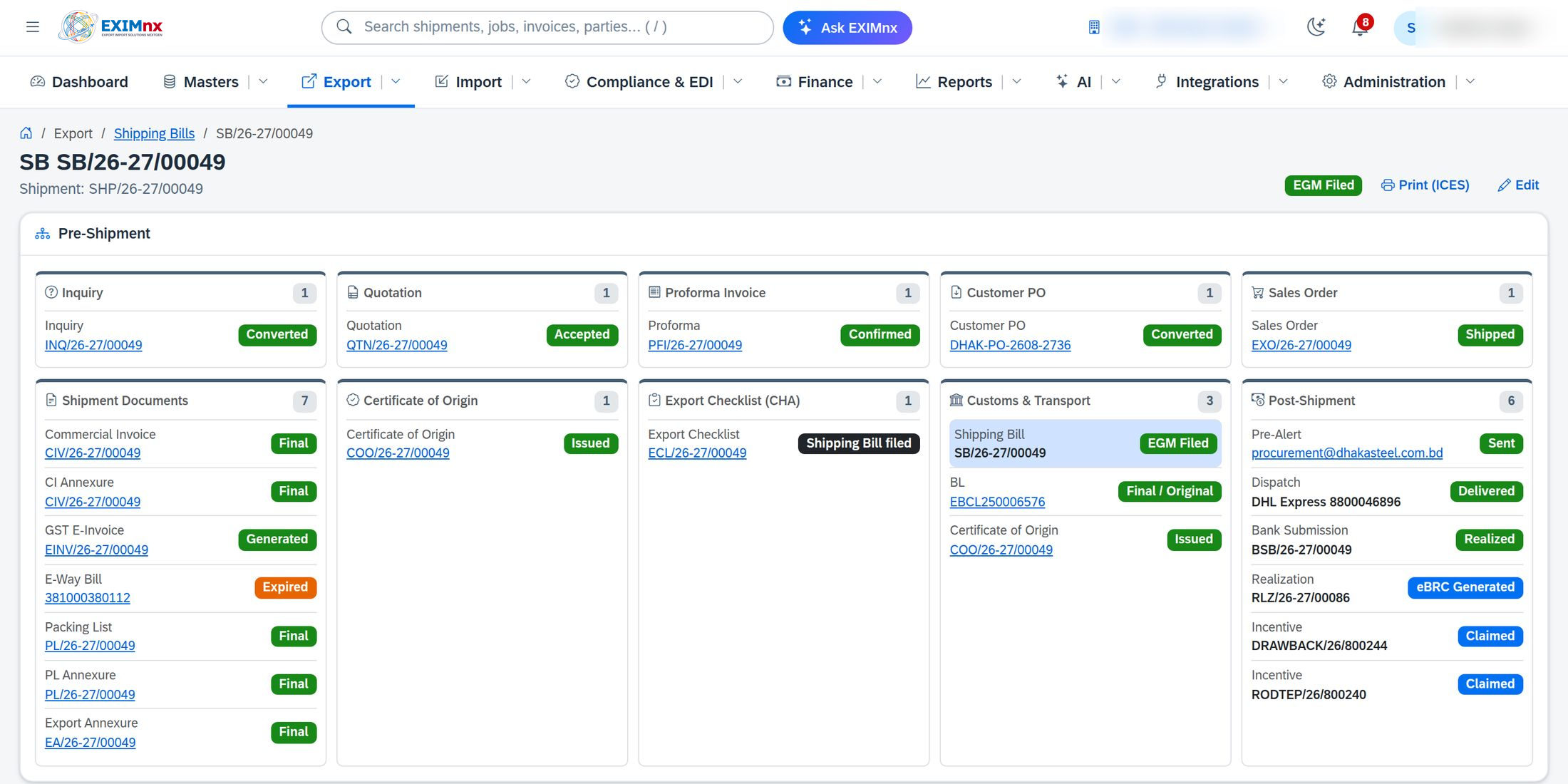
- Let Export Order (LEO) and BL/AWB. Customs assesses, examines if selected and gives LEO. The carrier then issues the bill of lading or airway bill.
- E-way bill. Needed for the road leg to port when the consignment value crosses the threshold. Validity is one day per 200 km for normal cargo (CGST Rule 138(10)). An e-way bill that lapses at the port gate is a common, avoidable delay.
- Pre-alert and dispatch. Send copies to the buyer, then send the original documents either to the buyer or through the bank, depending on the payment terms.
Bank submission, realisation and eBRC (steps 14–16)
- Bank submission. For collection or LC terms, submit the documents to your AD (authorised dealer) bank and keep the bank reference against the invoice.
- Realisation. When the buyer pays, match the bank credit to the invoice. Under FEMA the full export value must normally be realised within nine months of export (see compliance deadlines).
- eBRC. The bank reports the inward remittance to DGFT as an IRM. You map it to the shipment and generate the electronic Bank Realisation Certificate. Our eBRC guide covers this step by step.
Incentives, refunds and closure (steps 17–21)
- Incentives. Duty drawback and RoDTEP are claimed through the Shipping Bill itself. Track them to credit (see RoDTEP, drawback and IGST refund).
- IGST refund. For exports with IGST paid, the Shipping Bill is treated as the refund claim once the EGM and GST returns are filed. Track it from claim to scroll to bank credit.
- Licence credit. If the export discharges an Advance Authorisation or EPCG obligation, post it to that licence's ledger.
- RBI closure. Once the realisation is reported, the Shipping Bill entry in EDPMS is closed.
- Duty savings review. Total what the shipment earned in drawback, RoDTEP, IGST refund and licence benefits, so pricing for the next quotation reflects it.
Where the chain usually breaks
Invoice mismatches. A different invoice number or value on the Shipping Bill and in GSTR-1 is the most common reason an IGST refund stalls. Generate both from the same record.
Unmatched remittances. Part-payments, bank charges and advance receipts make IRM-to-invoice mapping hard. Unmapped IRMs mean no eBRC, and an open EDPMS entry.
How EXIMnx helps: each of the 21 steps is a screen in EXIMnx, and each document is generated from the previous one, with a flow panel showing what is missing. See the Export module.
- Central Board of Indirect Taxes and Customs: cbic.gov.in
- ICEGATE, the customs e-filing portal: icegate.gov.in
- Directorate General of Foreign Trade: dgft.gov.in
This guide is a practical overview, not legal advice. Check current notifications before acting.