

- Advance Authorisation (AA): duty-free import of inputs that go into an export product. The export obligation is normally due within 18 months of issue.
- EPCG: zero-duty import of capital goods. The obligation is exports worth six times the duty saved, within six years.
- Every import debit and every export credit must be traceable to the licence, or redemption turns into a duty-plus-interest demand.
AA and EPCG side by side
| Advance Authorisation | EPCG | |
|---|---|---|
| What you import | Inputs physically incorporated in the export product, plus fuel, packing material and catalysts allowed by the norms | Capital goods for pre-production, production and post-production |
| Duty relief | Basic customs duty and other duties, including IGST, are exempt on imports | Zero customs duty on the capital goods |
| Quantity basis | Standard Input Output Norms (SION) or ad hoc norms | Duty saved on the capital goods |
| Export obligation | Export the resulting product with the minimum value addition (generally 15%) | Exports worth 6× the duty saved, plus any average export obligation |
| Obligation period | 18 months from the date of issue | 6 years from the date of issue |
| Condition | Actual user: inputs are not transferable until the obligation is met | Installation certificate for the capital goods |
The clocks on each licence
Keeping the licence ledger
A licence is a running account. Treat it like one:
A licence ledger at a glance
Illustrative Advance Authorisation, in ₹ lakh. Imports used against the allowed CIF, and exports made against the required FOB.
Show as a table
| Line | Amount |
|---|---|
| Duty-free CIF allowed | ₹100 lakh |
| Duty-free CIF imported | ₹72 lakh |
| Export FOB required | ₹160 lakh |
| Export FOB achieved | ₹118 lakh |
Redemption and EODC
- Confirm the export quantity and value meet the obligation, including value addition for AA.
- Collect the Shipping Bills (with their licence details) and the realisation evidence, usually eBRCs.
- Reconcile the imports actually made against the inputs consumed under the norms; unused imports must be accounted for.
- File the EODC / redemption application with DGFT online.
- Once DGFT issues the redemption letter, have customs cancel the bond or undertaking given at the port of registration.
Where licences go wrong
The obligation period runs out unnoticed. The duty saved then becomes payable with interest. Watch days remaining, not just percentage complete.
Exports not linked to the licence. If the Shipping Bill did not quote the authorisation, the export may not count. Get it right at filing.
Realisation missing. An export without realisation proof does not discharge the obligation. See our eBRC guide.
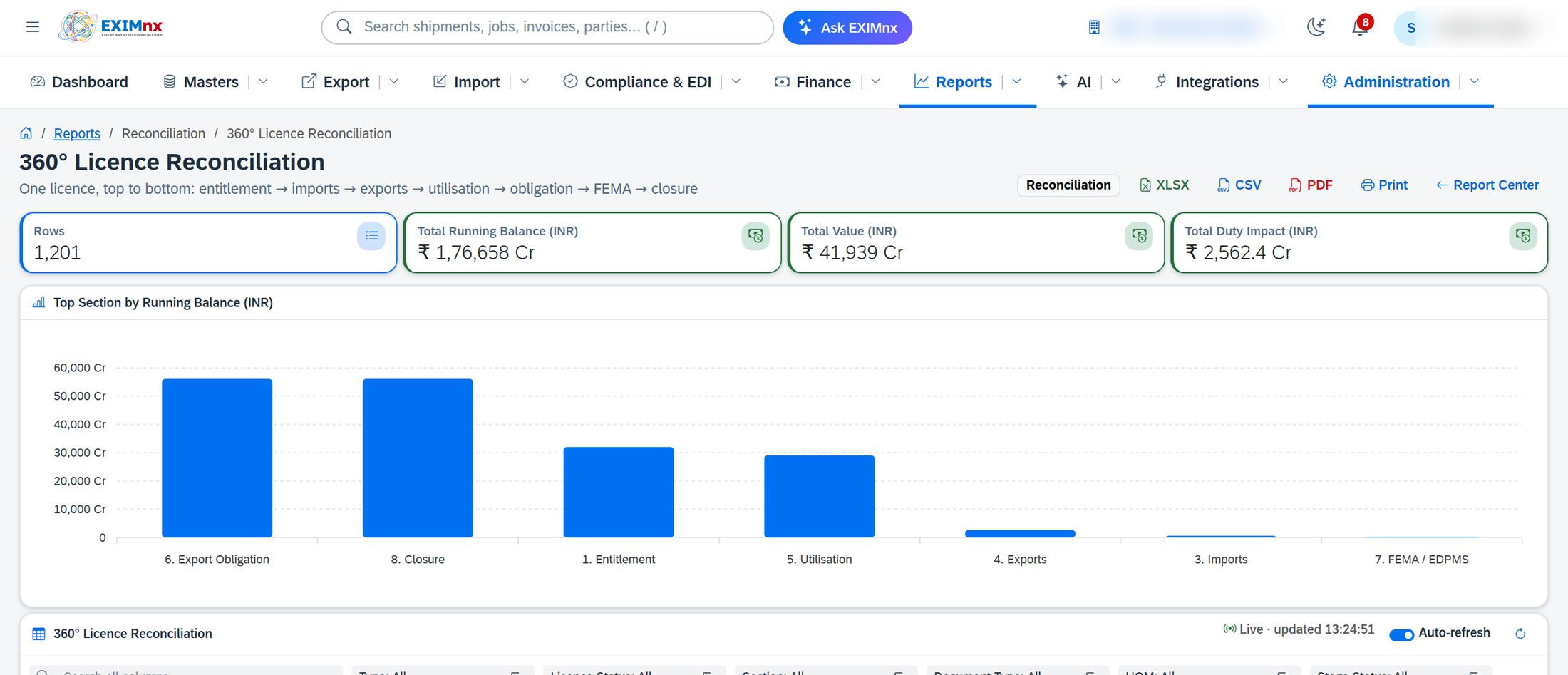
How EXIMnx helps: Bills of Entry debit and Shipping Bills credit each authorisation ledger automatically, with utilisation, expiry alerts and a 360° view per licence. See DGFT licences.
- Foreign Trade Policy 2023, chapters 4 (duty exemption) and 5 (EPCG), and the Handbook of Procedures: dgft.gov.in
This guide is a practical overview, not legal advice. Periods and conditions can change by notification; check the current FTP and Handbook of Procedures.