

- 9 months to realise export proceeds; 6 months to pay for imports. Both are tracked by RBI systems (EDPMS and IDPMS).
- 18 months to meet an Advance Authorisation obligation; 6 years for EPCG.
- 2 years to file a GST refund claim; an e-way bill lasts 1 day per 200 km.
The deadlines on one chart
How long each clock runs
Months from the start event. Hover or tab to a bar for the rule.
Show as a table
| Deadline | Time limit | Clock starts | Authority |
|---|---|---|---|
| Import payment (IDPMS) | 6 months | Date of shipment | RBI |
| Export realisation (EDPMS) | 9 months | Date of export | RBI / FEMA |
| Advance Authorisation import validity | 12 months | Date of issue | DGFT |
| Advance Authorisation export obligation | 18 months | Date of issue | DGFT |
| GST refund application | 2 years | Relevant date | GST (CGST Act s.54) |
| EPCG export obligation | 6 years | Date of issue | DGFT |
| E-way bill validity | 1 day per 200 km | Generation | GST (CGST Rule 138(10)) |
Export realisation and EDPMS
Customs sends Shipping Bill data to EDPMS. When the buyer pays, your AD bank reports the realisation and closes the entry. Entries left open past the due date are flagged, and an exporter with long-outstanding bills can be placed on RBI's exporters' caution list, which brings closer scrutiny of future shipments.
Short realisation (buyer paid less, quality claim, bank charges) still needs to be reported and closed through the bank, with documents. An unexplained shortfall keeps the entry open.
Import payments and IDPMS
The mirror image for imports: payment for normal imports should be made within six months of shipment. Every Bill of Entry is reported to IDPMS and must be matched to the outward remittance that paid for it. Advance payments must be followed by proof of import, a Bill of Entry, within the time allowed.
Licence obligations
An Advance Authorisation must normally be used for imports within 12 months and its export obligation met within 18 months of issue. EPCG gives 6 years to export six times the duty saved. Both need the obligation proven (Shipping Bills plus realisation) and closed with an EODC. See our licence guide.
GST: refunds and e-way bills
- Refund claims (LUT exports, unused input credit) must be filed within two years of the relevant date. IGST refunds through customs need GSTR-1 and GSTR-3B filed for the period, so late returns mean late refunds. See RoDTEP, drawback and IGST refund.
- E-way bills last one day per 200 km for normal cargo (20 km for over-dimensional cargo). Plan the port-gate cut-off with that in mind.
Building a deadline system
Deadlines get missed because they live in different places: realisation in the bank, licences at DGFT, refunds on the GST portal. A workable system needs:
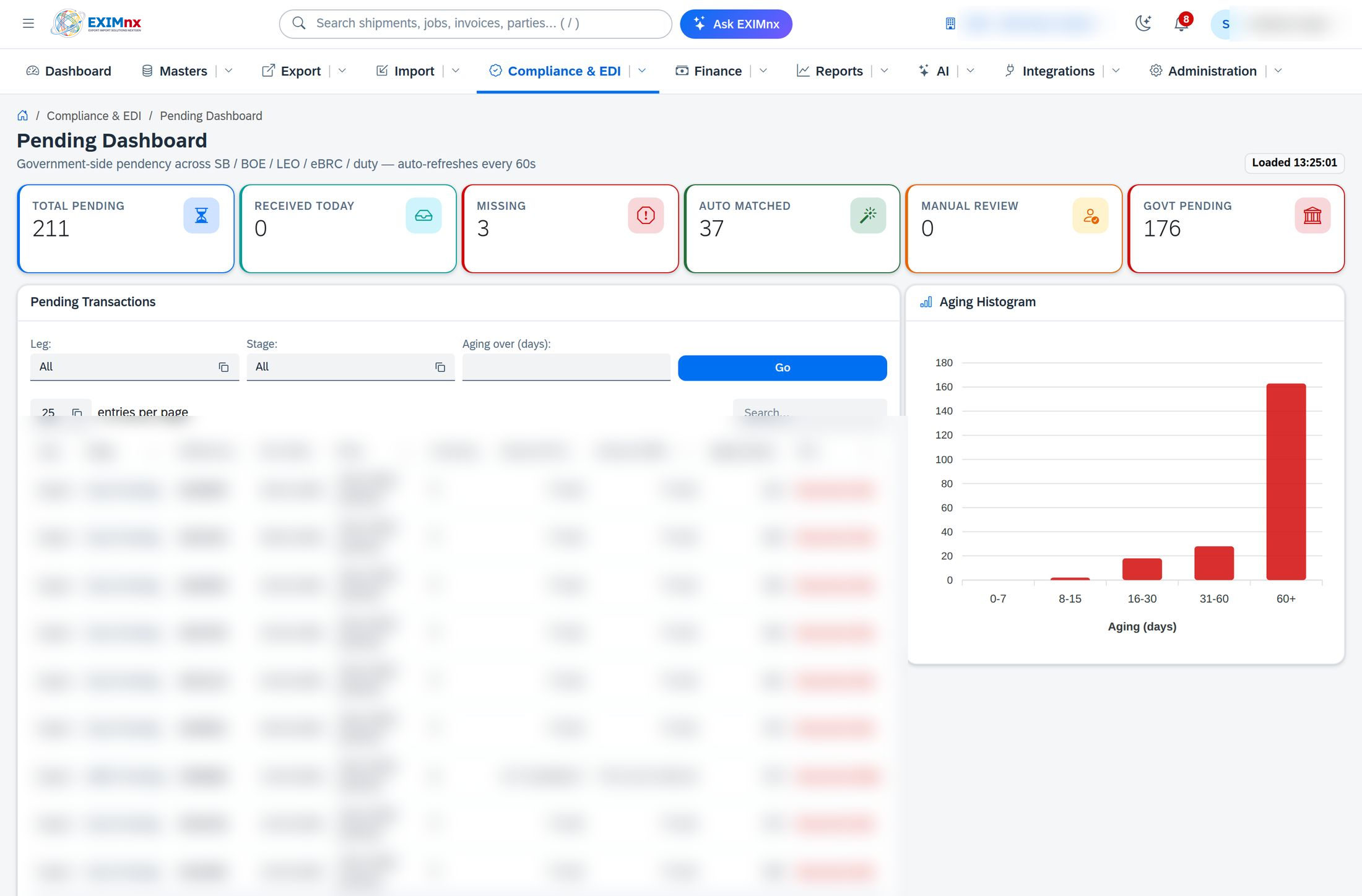
How EXIMnx helps: EXIMnx computes these deadlines from the documents themselves, flags FEMA overdue items at nine months, derives EDPMS and IDPMS positions from shipments and bank data, and puts every open item on one dashboard. See Compliance & EDI.
- RBI Master Directions on Export of Goods and Services and on Import of Goods and Services: rbi.org.in
- Foreign Trade Policy 2023 and Handbook of Procedures: dgft.gov.in
- CGST Act and Rules: cbic.gov.in
This guide is a practical overview, not legal advice. Time limits and extensions change by notification.