

- An Incoterms® rule fixes two separate things: where risk passes to the buyer and which costs the seller pays. With the C-terms they happen at different points.
- For containerised cargo, FCA and CIP usually fit better than FOB and CIF, because you hand the container over at a terminal, not over the ship's rail.
- Whatever you quote, the Indian Shipping Bill declares an FOB value. On a CIF or CFR invoice, freight and insurance must be deducted, and drawback and RoDTEP are calculated on that FOB figure.
The 11 rules on one chart
Incoterms 2020 has eleven rules in two groups. Seven work for any mode of transport, including multimodal container moves. Four are only for sea and inland waterway transport.
Risk and cost are two different lines
The C-terms catch people out. Under CIF Rotterdam you pay the ocean freight to Rotterdam, but if the vessel sinks mid-ocean the loss is the buyer's, because risk passed once the goods were on board at Nhava Sheva or Mundra. That is exactly why CIF and CIP oblige the seller to buy insurance for the buyer's benefit.
Who arranges what
| Rule | Export clearance | Main carriage | Insurance | Import clearance & duty |
|---|---|---|---|---|
| EXW | Buyer | Buyer | Not required | Buyer |
| FCA | Seller | Buyer | Not required | Buyer |
| FAS | Seller | Buyer | Not required | Buyer |
| FOB | Seller | Buyer | Not required | Buyer |
| CFR | Seller | Seller | Not required | Buyer |
| CIF | Seller | Seller | Seller, minimum ICC (C) | Buyer |
| CPT | Seller | Seller | Not required | Buyer |
| CIP | Seller | Seller | Seller, ICC (A) | Buyer |
| DAP | Seller | Seller | Not required (seller's own risk) | Buyer |
| DPU | Seller | Seller | Not required (seller's own risk) | Buyer |
| DDP | Seller | Seller | Not required (seller's own risk) | Seller |
EXW is awkward for Indian exports. Under EXW the buyer is responsible for export clearance, but an Indian Shipping Bill is filed under the exporter's IEC, and the export benefits and the FEMA realisation obligation sit with you. If the buyer wants to collect from your door, FCA at your premises is usually the cleaner choice.
DDP means you are the importer of record in the buyer's country: import duty, local taxes and registration there. Quote it only if you can actually do that.
Why FOB and CIF often don't fit containers
FOB, FAS, CFR and CIF were written for goods loaded onto the ship at the port. A container is usually handed to the carrier at an inland container depot, CFS or port terminal, days before it is loaded. Under FOB you keep the risk through that period, while the container is in the carrier's hands, not yours.
- FCA passes risk when you hand the goods to the buyer's carrier at the named place. It is the container equivalent of FOB.
- CPT and CIP are the container equivalents of CFR and CIF.
- Incoterms 2020 also added an FCA option for an on-board bill of lading. The parties can agree that the buyer instructs its carrier to issue an on-board B/L to the seller, which matters when a letter of credit demands one.
Insurance under CIF and CIP
The parties can agree different cover, and an LC may specify its own. Check that the policy matches the sales contract and the credit before you ship.
What the term means for your Shipping Bill
Indian customs assesses exports on FOB value. The Shipping Bill records the invoice value and Incoterm, then the freight and insurance included in that value, and arrives at FOB. The FOB figure then drives most of what follows:
- Incentives: drawback and RoDTEP rates apply to FOB value. Overstating freight lowers your FOB and your benefit; understating it overstates FOB, which customs may question.
- Realisation: the bank expects the full invoice value to be realised, CIF if you sold CIF, within the FEMA period. Freight you prepaid is part of what the buyer owes you. See compliance deadlines.
- Licences: Advance Authorisation and EPCG export obligations are generally counted on FOB value. See our licence guide.
- Consistency: the Incoterm and values on the invoice, Shipping Bill, bill of lading, insurance certificate and any LC must agree. A mismatch is a classic documentary-credit discrepancy.
Choosing a term
| If you… | Consider |
|---|---|
| ship containers and the buyer controls freight | FCA (named ICD, CFS or terminal) |
| ship containers and you can buy freight cheaper | CPT, or CIP if the buyer wants insurance |
| ship bulk or break-bulk loaded at the port | FOB, CFR or CIF |
| sell under an LC that needs an on-board B/L | FCA with the on-board B/L option, or a C-term |
| have a delivered-price buyer and a reliable forwarder at destination | DAP or DPU; DDP only if you can be the importer there |
Always name the place precisely, with the version: "FCA ICD Tughlakabad, Incoterms 2020", not just "FCA Delhi". An Incoterms rule says nothing about when title passes or how payment is made. Those belong in the sales contract.
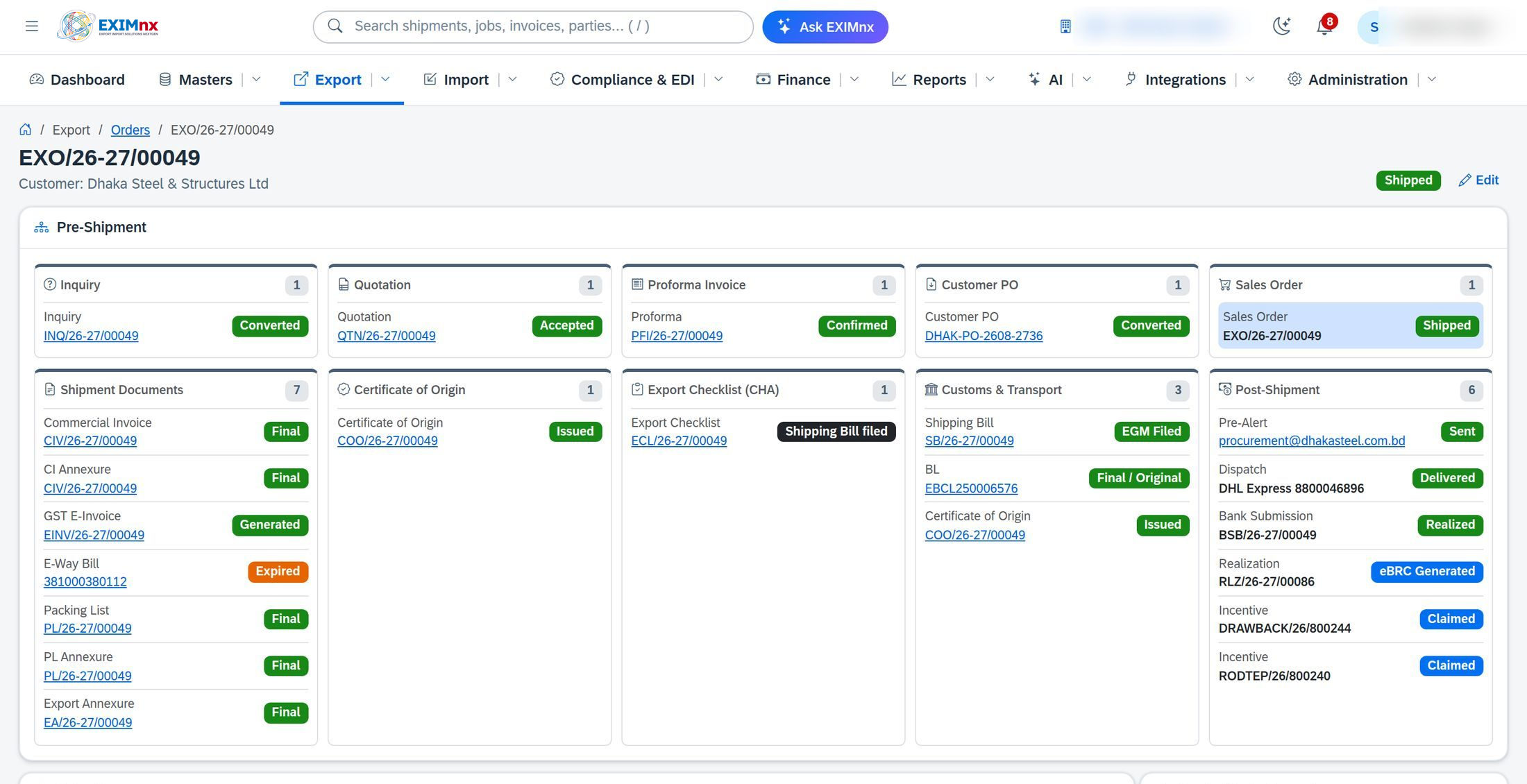
How EXIMnx helps: the Incoterm is recorded on the quotation and sales order and flows into the commercial invoice and the Shipping Bill, so the term never has to be retyped. Sales orders are gated by payment mode (advance, LC, DA or DP), so production starts only on the terms you agreed. See the Export module.
- International Chamber of Commerce, Incoterms® 2020: iccwbo.org
- CBIC (export valuation, Shipping Bill): cbic.gov.in
Incoterms® is a registered trademark of the International Chamber of Commerce. This guide is a practical overview, not legal advice; refer to the ICC's official Incoterms® 2020 text for the full rules.