
- Screen the parties (buyer, consignee, end user, notify party, banks, agents) against the major sanctions lists: UN, US OFAC SDN and the US Consolidated Screening List, UK and EU.
- Screen the goods against India's SCOMET list. SCOMET items need a DGFT licence before export.
- Screen at several points, not once: onboarding, order, shipment, payment, and again whenever the lists change. Record every decision.
Why Indian exporters need to screen
India implements UN Security Council sanctions, but a US, UK or EU listing is not Indian law. Indian exporters still screen against those lists, because the money and the goods pass through systems that do follow them.
The lists that matter
| List | Owner | What it covers | Official source |
|---|---|---|---|
| UN Security Council Consolidated List | United Nations | Individuals and entities under UN sanctions regimes (asset freezes, travel bans, arms embargoes) | un.org |
| OFAC SDN List | US Treasury | Specially Designated Nationals and Blocked Persons; assets blocked, US persons barred from dealing | ofac.treasury.gov |
| US Consolidated Screening List | US Commerce, State, Treasury | One search across US export-control and sanctions lists, including the Entity List and Denied Persons List | trade.gov |
| UK sanctions list | UK Government (OFSI for financial sanctions) | Persons and entities designated under UK sanctions regulations | gov.uk |
| EU consolidated financial sanctions list | European Commission | Persons, groups and entities subject to EU financial sanctions | sanctionsmap.eu |
Ownership counts too. Under US and EU rules, a company majority-owned by a listed party can be treated as blocked even when it is not named. Ask about beneficial ownership for higher-risk buyers.
SCOMET: India's own export control list
SCOMET stands for Special Chemicals, Organisms, Materials, Equipment and Technologies. It is India's list of dual-use items (goods, software and technology with both civilian and military uses), published as Appendix 3 to Schedule 2 of the ITC(HS) export classification.
- Exporting a SCOMET item needs an authorisation from DGFT (or, for some categories, the department designated for them) before the goods are shipped.
- The catch-all rule: even an item not on the list needs authorisation if you know, or have reason to believe, it is intended for weapons of mass destruction or their delivery systems.
- Check the item's description and specifications against the SCOMET categories, not only its HS code. The list is defined by technical parameters, and HS codes are an imperfect guide.
When to screen
Lists change every week. A buyer who was clean at onboarding can be designated before shipment, so a single check is not enough:
Screen every party on the documents: the buyer, the consignee (who can differ from the buyer), the end user, the notify party, freight forwarders and agents, and the banks on a letter of credit. Sanctioned parties often appear in the role that gets the least scrutiny.
Handling potential matches
Names are transliterated, abbreviated and misspelled, so screening uses fuzzy matching. That catches "Mohammed" vs "Muhammad", but it also produces false positives: a common name or a word like "Trading" can match dozens of entries. Every hit needs a decision:
- Compare identifiers, not just the name: address, country, date of birth or registration, registration numbers and known aliases in the list entry.
- Clear it if the identifiers clearly differ. Write down why, for example "different country and registration number".
- Escalate if you cannot tell. Hold the transaction and ask for more information from the party, your bank or legal counsel.
- Block a true match. Do not ship, do not accept payment, and take advice on any reporting duty.
Don't tune the matching threshold down to get rid of false positives. A missed true match costs far more than reviewing ten false ones. Use an allow-list of cleared parties instead, so a decision is only reviewed again when the party or the list changes.
Keeping an audit trail
If a bank, customs or a regulator asks, you need to show that you screened, not just say so. For each check keep:
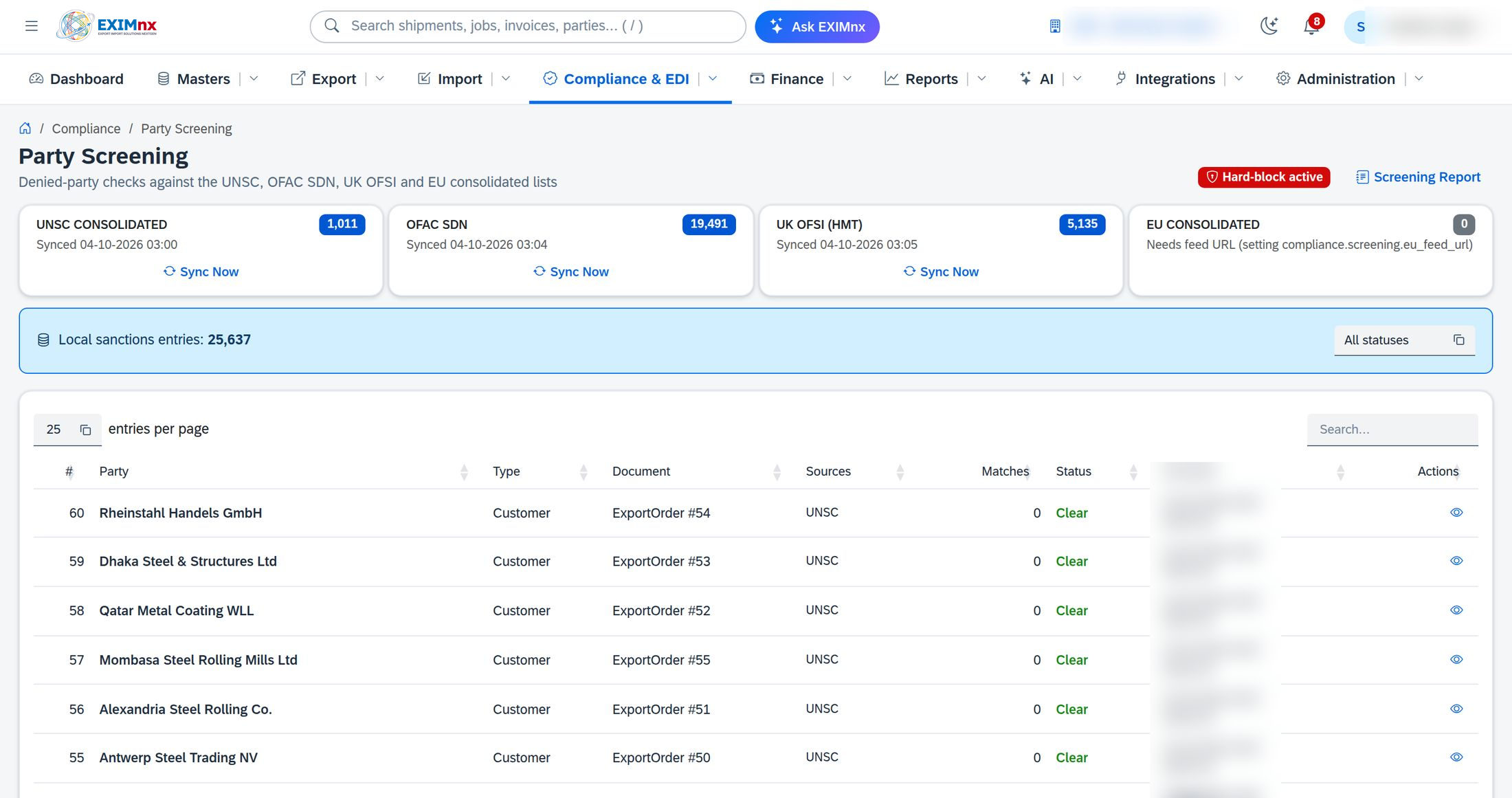
How EXIMnx helps: parties are screened against the UNSC, OFAC SDN, UK OFSI, EU and US CSL lists, resynced weekly. An ITC(HS) policy check and a SCOMET gate run before filing, and transaction risk scores feed a compliance monitor. See Compliance & EDI.
- DGFT: ITC(HS) Schedule 2, Appendix 3 (SCOMET) and SCOMET authorisation: dgft.gov.in
- UN Security Council Consolidated List: un.org/securitycouncil
- US OFAC sanctions lists: ofac.treasury.gov
- US Consolidated Screening List: trade.gov
- UK Office of Financial Sanctions Implementation: gov.uk
This guide is a practical overview, not legal advice. Sanctions and export-control rules change often; take advice on any potential match.